
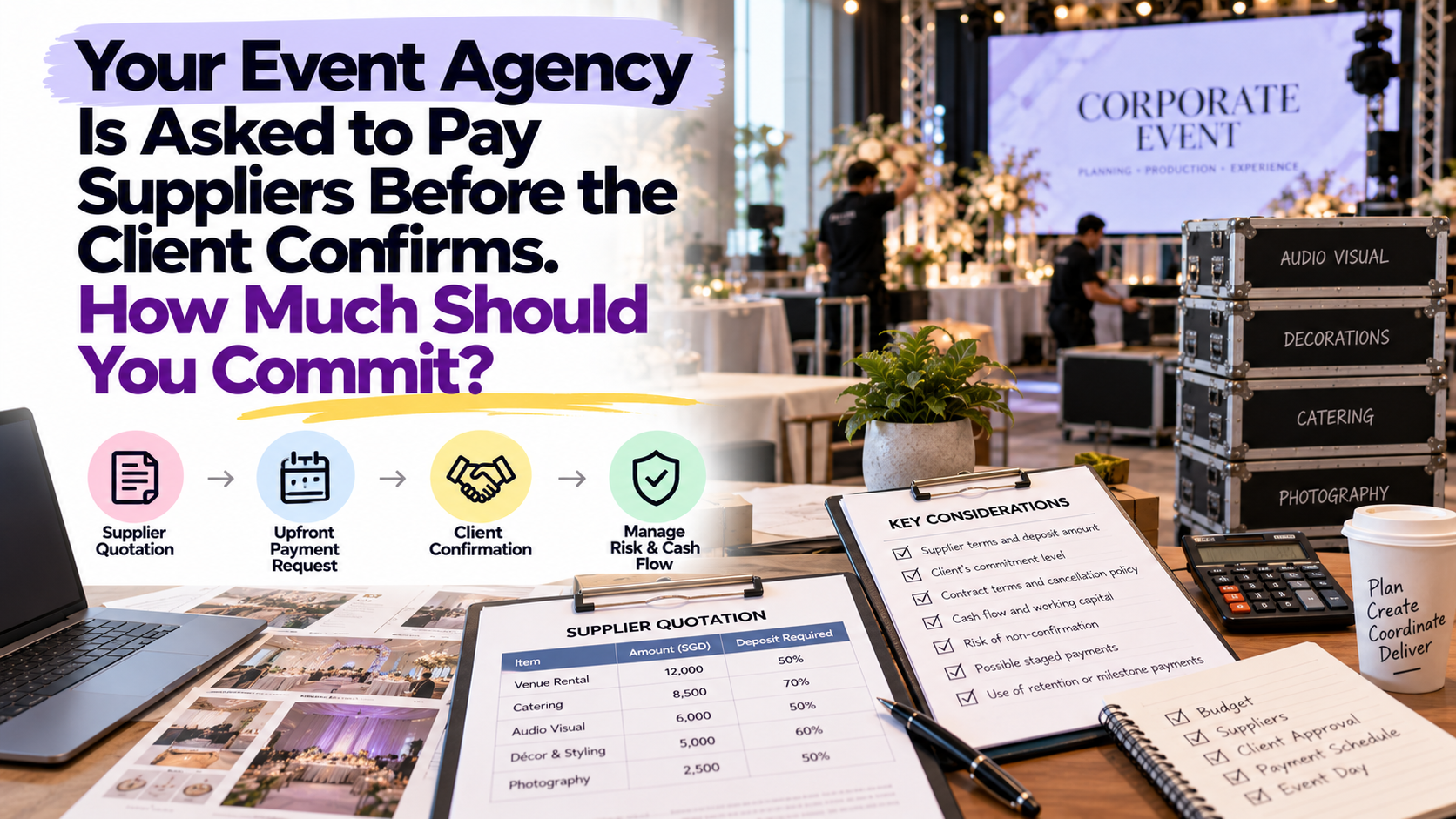
The client likes the proposal. The event date is approaching, and your preferred venue says another organiser is interested. Meanwhile, the production supplier needs a deposit to reserve equipment, and the fabricator wants approval before starting the customised backdrop.
Your account manager is confident the event will proceed. The client’s procurement team is still processing the paperwork, but everyone expects confirmation soon. Paying suppliers now could protect availability and keep the project on schedule.
For the agency owner, however, each payment creates exposure before the commercial position is clear. If the client postpones, reduces the scope or appoints another agency, some spending may be recoverable and some may not. The decision needs to reflect both the cash temporarily tied up and the amount the agency could ultimately lose.
Clarify What Is Still Waiting for Confirmation
“Not confirmed yet” can describe several different situations. The client may have approved the event internally but not appointed your agency. It may have appointed your agency while leaving the budget unresolved. Alternatively, the scope and price may be agreed while an administrative document remains outstanding.
Establish the actual position before authorising spending. Identify what the client has approved, who provided that approval and which decisions remain open. Keep the relevant correspondence together with the proposal and commercial terms.
A verbal assurance, signed agreement, purchase order and cleared payment serve different purposes. None should be treated as a universal shortcut for assessing the entire arrangement. Where the authority to proceed or responsibility for cancellation costs is unclear, obtain appropriate clarification and legal advice.
The financial question is what your agency can reasonably expect to recover if the project changes today. Confidence in the relationship is useful context, but it should be supported by an understanding of the agreed obligations.
Separate Urgent Spending From Spending That Can Wait
Supplier deadlines can make every decision feel immediate. However, reserving a venue, ordering generic equipment and beginning custom fabrication do not necessarily require the same level of commitment at the same time.
Ask each supplier what is needed to preserve availability and what can be deferred. There may be a short provisional hold, a smaller reservation payment or an option to confirm part of the order first. These possibilities depend on the supplier, so obtain clear terms rather than assuming flexibility.
Examine what happens if you wait. Losing a preferred supplier may create inconvenience, but an alternative could still deliver the event at an acceptable cost. For a genuinely scarce venue or specialist resource, the commercial case for an early commitment may be stronger.
Prioritise spending that protects a specific requirement. Avoid approving the entire supplier package simply because one element has an immediate deadline.
Measure More Than the Deposit
A deposit is the first payment, but it may not represent the maximum commitment. Accepting an order could expose the agency to further charges, particularly once work begins or a cancellation deadline passes.
Prepare a commitment schedule for the project. Show the total agreed amount, payments made, balances payable, cancellation terms and the next date on which exposure changes. Keep recoverable cash separate from supplier credits.
A credit for a future event is not equivalent to money returned to your bank account. It may expire, apply only to certain services or require further spending before it can be used. Its practical value depends on whether your agency has a suitable use for it.
Also distinguish between a requested quotation and an accepted instruction. Project teams should know which actions authorise work, including email approvals or online booking confirmations. Finance needs visibility before those actions create commitments.
Calculate the Loss If the Event Stops Today
Consider a hypothetical agency that is considering three early supplier payments. A venue requires S$12,000, an audiovisual supplier requires S$8,000, and a fabricator requires S$5,000 to begin customised work. The immediate cash outflow is S$25,000.
Assume the documented terms allow the venue to refund S$9,000 if cancellation occurs before a specified deadline. The audiovisual supplier would refund S$6,000, while the fabrication payment would be entirely non-refundable once work begins.
Under those assumptions, cancellation before the deadline would leave S$10,000 unrecovered: S$3,000 for the venue, S$2,000 for audiovisual services and S$5,000 for fabrication. This assumes there are no additional cancellation charges or useful recoveries from the customised materials.
The agency therefore faces two different amounts. It needs S$25,000 in cash now, and its identified supplier loss on cancellation is S$10,000. The timing of the S$15,000 refund also matters because the cash may remain unavailable for some time.
If the venue’s terms become fully non-refundable after the deadline, the potential loss rises to S$19,000, assuming the other terms stay unchanged. That deadline should trigger a fresh decision rather than pass unnoticed while the team waits for the client.
Do Not Assume a Client Deposit Covers Every Scenario
Receiving money from the client can reduce the funding gap, but management still needs to understand what that payment covers. The amount may be refundable under certain circumstances or relate to a narrower scope than the supplier commitments being made.
Match the client’s authorised scope against the spending. Approval to reserve a venue does not necessarily establish authority to begin custom production or appoint additional contractors. Record subsequent instructions where they expand the commitment.
In the hypothetical example, a S$10,000 client payment would reduce the immediate cash gap from S$25,000 to S$15,000. It would only offset cancellation losses to the extent that the agreed terms support retaining or applying it against those costs.
Avoid treating an expected payment as though it has already arrived. The client may intend to pay promptly while its internal process takes longer. Keep promised receipts and cleared funds distinct in the cash forecast.
Include Internal Work in the Commercial Review
External payments are easier to see than the time your team spends developing an event. Design revisions, supplier coordination, site visits and production planning can consume substantial capacity before the appointment is settled.
Track this work at a level proportionate to the project. The aim is to understand how much effort the opportunity requires and whether it displaces confirmed, paying work. A project with modest supplier deposits may still carry a significant internal commitment.
Distinguish additional cash spending from existing payroll. Staff time does not automatically create a new cash outflow where salaries would be paid anyway, but it can still have an opportunity cost. Overtime, freelancers and extra travel may create direct additional spending.
Consider whether a defined pre-production phase could be agreed with the client. A separately authorised scope can clarify what work is being requested and how it will be paid for while the main event remains under discussion.
Set the Limit Against the Agency’s Available Cash
The proposed event’s size should not be the only basis for approving early spending. A S$25,000 commitment may be manageable for one agency and disruptive for another, depending on existing obligations and collections.
Review the agency’s cash forecast across all active projects. Include payroll, supplier balances, operating expenses and expected receipts. Identify the lowest projected cash balance if the new client’s payment is delayed.
Keep a slower-refund scenario in view as well. Even a recoverable supplier payment can strain the business if the refund arrives after other commitments fall due. Recoverability and liquidity answer different questions.
Management should set a limit that the agency can absorb without undermining confirmed work. The bank balance alone is not the available spending budget if much of it is already needed for other projects and routine payments.
Assess Delay and Scope Reduction as Well as Cancellation
An event does not have to be cancelled to create a loss. A date change can make a venue booking unusable, while a smaller guest count may leave the agency committed to equipment or production quantities it no longer needs.
Ask suppliers how changes affect their charges. Identify the point at which quantities become fixed and whether a postponement is treated differently from cancellation. Record any restrictions on transferring deposits to a new date.
Build a scenario around the most uncertain parts of the proposal. If attendance is provisional, examine the exposure from confirming catering quantities early. If branding is unresolved, consider the cost of starting printed or fabricated materials.
This review should influence the order of decisions. Work that is difficult to reverse deserves stronger confirmation than a provisional reservation that can be released with little cost.
Use Approval Stages Instead of One Open-Ended Budget
A total project budget does not explain how much should be committed before the client confirms. Establish specific approval stages tied to evidence and financial exposure.
For example, management might authorise a limited reservation payment while requiring further approval before custom fabrication begins. The next stage could depend on an agreed scope, specified client authorisation and receipt of the required funds.
State the limit in a way that captures the real commitment. A cap based only on payments made can miss unpaid supplier obligations already accepted. Include both cash paid and additional amounts the agency may have to pay.
Name the person responsible for monitoring the limit and the next decision date. Account managers and production staff need a clear route for escalating urgent requests rather than relying on informal assurances that the project is likely to proceed.
Make the Client’s Decision Concrete
A useful client update explains what needs to be decided, by when and with what financial consequence. Instead of asking generally for confirmation, identify the specific booking or production instruction awaiting approval.
For example, explain that the venue can be held until a stated date, after which availability may change. If payment would create a non-refundable commitment, explain that consequence accurately and seek the corresponding instruction under the agreed process.
Offer realistic alternatives where available. The client may prefer another venue, a smaller initial production order or a revised timetable rather than accepting the proposed exposure.
Avoid creating artificial urgency. The purpose is to help the client make an informed decision and establish a clear record of the instruction. That record also helps your own team distinguish approved spending from work still under consideration.
Keep the Decision Independent of Money Already Spent
Once an agency has paid a deposit, there can be pressure to keep spending so that the earlier payment does not feel wasted. That is particularly common when a project has attracted significant creative effort and internal enthusiasm.
Review each additional commitment on its future consequences. An existing non-refundable payment may already be unavoidable, while the next payment remains optional. Spending more does not necessarily improve the chance of recovering the first amount.
Management can still decide that further investment is commercially justified, but the reasoning should be explicit. Identify what the additional payment secures, what evidence supports proceeding and how much more the agency could lose.
Use the original approval assumptions as a reference. If client timing, scope or payment expectations have changed, reconsider the spending limit instead of continuing under an outdated approval.
Build a Record That Supports the Next Decision
Maintain a project file containing client instructions, supplier terms, commitments, payment records and upcoming deadlines. Update it when scope or dates change so that finance and operations work from the same information.
Keep cash exposure separate from accounting classification. A supplier deposit, a cancellation charge and work already received may require different treatment in the accounts. Calling everything “project cost” can obscure both recoverability and the current financial position.
Kazuma provides bookkeeping and periodic financial reporting services. Clear project records give an agency’s management and accounting team a stronger basis for monitoring supplier balances, outstanding client payments and the effect of early commitments on available cash.
There is no single percentage of an event budget that every agency should spend before confirmation. The appropriate amount depends on the evidence of client commitment, supplier terms, potential loss and the agency’s capacity to fund the gap. Establish those limits before urgency turns a promising opportunity into an obligation the business cannot comfortably carry.