
A Simple 10% Target Can Become a Complicated Business Decision
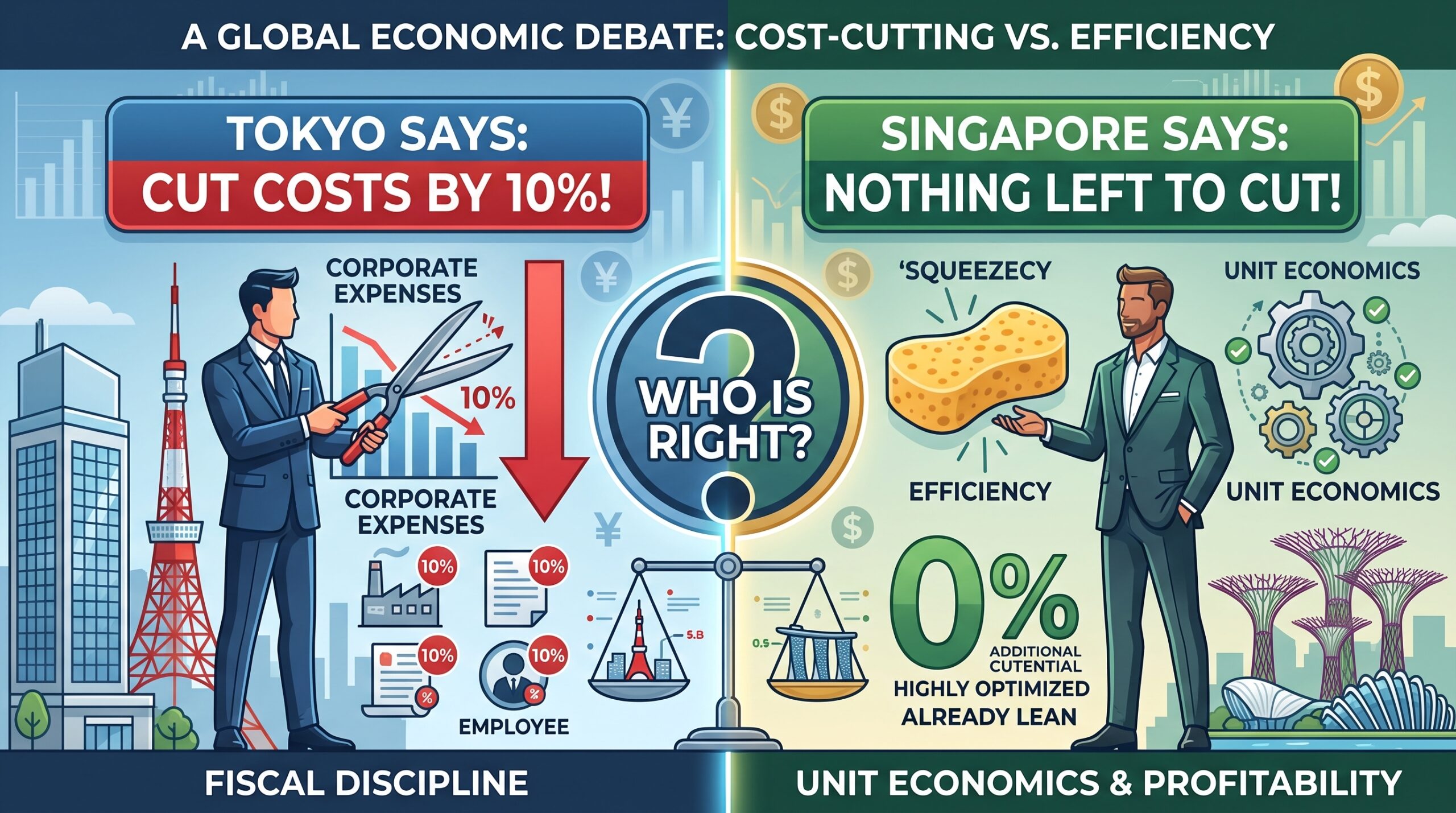
The instruction from head office sounds straightforward: reduce operating costs by 10% next year. Tokyo has reviewed the group’s performance, economic conditions remain uncertain, margins need protection and every overseas subsidiary has been asked to contribute. Singapore management opens the budget and immediately sees a problem. Office rental is committed under a lease, salaries make up a large proportion of expenditure, professional and regulatory costs cannot simply disappear, technology contracts are already negotiated, and several departments insist they are operating with minimal resources. Singapore replies that there is almost nothing left to cut. From Tokyo’s perspective, that answer can sound defensive. From Singapore’s perspective, the 10% instruction can sound disconnected from local reality. The interesting question is not whether Tokyo or Singapore is correct. Both may be looking at legitimate information. The real management challenge is determining whether the company can reduce costs without reducing the capabilities, controls and customer relationships that generate its future revenue.
Ten Percent Looks Very Different at Group Level and Subsidiary Level
A parent company managing businesses across several countries naturally looks at costs differently from a local subsidiary. Head office may see Singapore’s annual operating expenditure of S$10 million and conclude that a 10% reduction means finding S$1 million of savings. On a spreadsheet, the calculation takes seconds. Local management sees what sits inside that S$10 million. Perhaps S$4 million is payroll, S$1.5 million is rent and property-related expenditure, S$1 million relates to technology and systems, S$800,000 goes towards logistics, S$700,000 supports professional, compliance and administrative requirements, and the remaining S$2 million covers numerous operational expenses. Once contractual commitments and essential functions are separated from genuinely discretionary spending, finding S$1 million may require much more significant changes than the percentage initially suggests. This difference in perspective is one reason cost discussions between headquarters and subsidiaries can become frustrating even when both sides are acting rationally.
Singapore Is Expensive, but Cost Alone Does Not Explain Value
Singapore is not usually selected as a regional business location because it is the cheapest place in Asia to employ people, rent an office or operate sophisticated corporate functions. Companies often establish substantial operations in Singapore because of its connectivity, professional ecosystem, regulatory environment, access to talent and ability to support regional activities. A Japanese parent comparing Singapore’s absolute operating costs with another ASEAN market therefore needs to consider what each office actually does. A Singapore employee costing more than an employee elsewhere does not automatically mean the Singapore employee creates less value. The Singapore operation may be managing regional customers, treasury, finance, procurement, technology, compliance or management responsibilities extending beyond the domestic market. Cost comparisons become useful only when management also compares functions, productivity, risk and value created. Otherwise, the cheapest office can appear to be the most efficient simply because the spreadsheet ignores what each location is expected to deliver.
Start by Asking Why Tokyo Wants 10%
Before Singapore management begins cancelling subscriptions or freezing recruitment, it should understand the purpose behind the target. Is the group facing a temporary decline in demand? Are margins deteriorating? Has the parent company promised investors a particular level of efficiency improvement? Is cash preservation the priority? Does management believe overseas subsidiaries have accumulated unnecessary costs? Or is the 10% simply a group-wide target applied equally to every business unit? The answer matters because different problems require different responses. If the objective is immediate cash preservation, management may prioritise expenditures that can be postponed without harming operations. If the concern is structurally weak profitability, temporary cuts will not solve the underlying problem. A serious cost programme should begin with the business objective rather than treating 10% as a number that must somehow be extracted from every line of the budget.
Singapore Should Also Be Able to Explain Why Nothing Can Be Cut
Saying “there is nothing left to cut” is not a complete management argument either. Almost every organisation has some expenditure that can be challenged, redesigned, renegotiated or eliminated. The question is whether the savings are large enough and whether the consequences are acceptable. Singapore management should be able to show head office how its cost base has changed, which expenses are fixed or contractually committed, which costs directly support revenue, where previous efficiency measures have already reduced spending and which areas still contain potential savings. If local management cannot explain the cost structure beyond saying that every department needs its existing budget, Tokyo has a legitimate reason to challenge it. A strong subsidiary should understand its cost base well enough to distinguish between “we cannot cut this” and “we can cut this, but here is what the business will lose if we do”.
Cutting Every Department by 10% Is Equal but Not Necessarily Rational
One of the easiest ways to implement a cost target is to tell every department to reduce its budget by the same percentage. It feels fair because everyone contributes equally. Unfortunately, equal percentage reductions do not necessarily create equal business consequences. A department with years of accumulated inefficiency may be able to remove 15% without materially affecting performance, while a lean department operating near capacity may struggle with a 5% reduction. A growing sales function may require more resources even while an administrative process can be simplified. Cybersecurity spending may need to increase despite an overall cost reduction programme. Treating every department identically can therefore protect inefficient spending while damaging strategically important functions. Management should allocate savings according to business value, efficiency opportunities and risk rather than assuming fairness means applying the same percentage to every cost centre.
Payroll Is Usually Where the Numbers Become Uncomfortable
When salaries represent a large share of expenditure, management may eventually discover that small discretionary cuts cannot produce a large group target. Cancelling staff events, reducing travel, negotiating cheaper stationery and eliminating minor subscriptions may create visible action but relatively little financial impact. If the target is S$1 million, the discussion can quickly move towards headcount, salary growth, vacancies, overtime and organisational structure. This is where cost reduction becomes much more difficult because employees are not merely entries in an expense ledger. They hold customer relationships, technical knowledge, institutional memory and operational capability. Reducing headcount may lower payroll immediately while increasing workload, turnover, service delays and dependence on remaining employees. Management therefore needs to understand what work disappears when a position disappears. If the work remains, the cost may simply move somewhere else.
A Hiring Freeze Does Not Freeze the Work
Suppose Singapore decides not to replace five employees who resign during the year. Head office sees a clear payroll saving. Yet customer enquiries continue, month-end reporting continues, regulatory deadlines remain, invoices still need processing and regional management still wants information. Someone must absorb the work. Existing employees may work longer hours, managers may spend more time performing junior tasks, projects may be postponed or external service providers may be engaged. The organisation can therefore report lower headcount while becoming less productive elsewhere. A hiring freeze can be sensible when vacancies genuinely reflect unnecessary capacity or when processes can be redesigned. It becomes dangerous when management treats an empty position as an automatic saving without asking what happened to the responsibilities previously attached to it.
The Cheapest Saving Can Create the Most Expensive Consequence
Cost reduction programmes sometimes prioritise expenses that are easiest to remove rather than those that create the least value. Training is postponed because cancelling a course is easy. Preventive maintenance is delayed because the machine still works today. Technology upgrades are pushed back because the old system has not yet failed. Marketing is reduced because the effect on future sales will not appear immediately. Control functions are stretched because their value is difficult to measure when nothing goes wrong. These actions improve this year’s expense line quickly, but some can create larger costs later. A poorly maintained asset eventually fails, an outdated system creates inefficiency, employees become less capable, or weak controls contribute to an avoidable loss. Good cost management considers the timing of both savings and consequences rather than celebrating reductions simply because the financial effect appears immediately.
Revenue-Protecting Costs Should Be Identified Before Cuts Begin
Not all expenditure should be viewed purely as something to minimise. Some costs directly protect or generate revenue. A key account manager may be expensive, but removing the role could put millions of dollars of customer relationships at risk. A technical support team may not generate revenue directly, but poor service could increase customer losses. A quality-control process may look like overhead until defective products reach customers. Management should therefore classify costs according to their role in the business. Which expenses generate revenue? Which protect revenue? Which manage significant risks? Which are necessary to operate? Which are genuinely discretionary? This approach creates a much more useful conversation than simply sorting the general ledger from largest to smallest and asking every department to spend less.
Small Costs Can Still Reveal Poor Discipline
The fact that major savings usually require structural changes does not mean small expenditure should be ignored. Unused software licences, duplicate subscriptions, unnecessary travel, poorly negotiated supplier contracts, excessive printing, dormant telephone lines and recurring services nobody remembers approving can collectively become meaningful. More importantly, they reveal something about management discipline. A company that does not regularly review small recurring costs may also be overlooking larger inefficiencies. However, management should keep the scale in perspective. Eliminating S$50,000 of unnecessary subscriptions is worthwhile, but it does not solve a S$1 million cost challenge. Small savings are useful when they form part of a broader review rather than becoming a distraction from difficult structural decisions.
Supplier Negotiation Can Produce Savings Without Reducing Capability
Cost reduction does not always require doing less. Sometimes the business can purchase the same or better outcome more efficiently. Long-standing supplier relationships should periodically be reviewed to determine whether pricing remains competitive, whether volumes justify different terms or whether services have expanded beyond what the business actually uses. Consolidating purchases across a regional group may strengthen negotiating power, while renegotiating payment terms can improve cash flow even if the headline cost does not change. However, management should resist choosing suppliers based only on the lowest quoted price. Reliability, quality, response time and switching risk matter. A supplier that costs 10% less but repeatedly disrupts operations can become far more expensive than the original provider.
Technology Costs Need a Usage Review, Not an Automatic Cut
Modern companies can accumulate a surprising number of software subscriptions. Different departments purchase collaboration tools, analytics platforms, project-management systems, AI applications and specialised services, sometimes with overlapping capabilities. This creates a genuine opportunity for rationalisation. Management can examine how many licences are active, which features employees use, whether multiple tools solve the same problem and whether group-wide contracts could reduce pricing. At the same time, technology should not automatically be targeted simply because subscriptions are visible and easy to cancel. A system costing S$100,000 annually may save considerably more than S$100,000 of employee time or reduce an important operational risk. The correct question is not “How much does this software cost?” but “What would it cost the organisation to perform the same work without it?”
Manual Work Is a Cost Even When It Does Not Have Its Own Expense Line
One reason subsidiaries sometimes insist they are already lean is that a significant amount of inefficiency is hidden inside payroll. Ten employees may each spend several hours a week copying information between systems, preparing repetitive reports, reconciling spreadsheets or correcting avoidable errors. The general ledger does not contain an account called “unnecessary manual work”, so the cost remains invisible. If Tokyo focuses only on reducing visible external spending, it may miss a larger opportunity to redesign processes. Automation, standardisation and better data integration can sometimes reduce the amount of labour required without reducing headcount immediately. The saved capacity can then be redirected towards higher-value work or used to absorb future growth without additional hiring. Sustainable efficiency often comes from changing how work is performed rather than merely asking people to do the same work with a smaller budget.
Head Office Reporting Itself Can Be Part of the Cost Base
A particularly relevant question for multinational subsidiaries is how much time employees spend reporting information upwards. Singapore may prepare statutory accounts, local management reports, regional reports, Japanese head-office templates, budget files, forecasts, consolidation packages and ad hoc explanations. Each request may be individually reasonable, but together they can consume substantial finance and management capacity. If Tokyo demands a 10% reduction while simultaneously increasing reporting requirements, the group should consider whether some internal work can be simplified. Does head office still need every report? Are multiple teams requesting the same information in different formats? Can data be extracted automatically rather than manually re-entered? Cost reduction should examine internal bureaucracy as seriously as external expenditure. Sometimes the parent company itself creates part of the subsidiary’s cost structure.
Different Definitions of Productivity Can Create Conflict
Tokyo may calculate revenue per employee and conclude that Singapore should operate with fewer people. Singapore management may respond that its employees perform regional functions that do not generate local revenue directly. Both calculations can be technically correct while answering different questions. Productivity needs to be measured in relation to what the team is responsible for delivering. Finance might be evaluated by transaction volumes, reporting speed and quality rather than sales. A regional management team might support revenue generated in several countries even though its cost sits in Singapore. Customer-service productivity might involve response time, resolution quality and retention rather than simply cases handled per employee. Before using productivity data to justify cost reductions, head office and the subsidiary need to agree on what output is actually being measured.
Budget History Can Protect Costs That No Longer Make Sense
Another common problem is incremental budgeting. Last year’s budget becomes the starting point, departments add expected inflation or new requirements, and management debates the increase. This approach can preserve expenditure long after its original purpose disappears. A service introduced for a project five years ago may still be renewed. A reporting process created during an acquisition may continue even after integration is complete. A team structure designed for an older business model may remain untouched. Cost pressure can therefore provide a useful reason to challenge historical assumptions. Instead of asking only how to reduce last year’s budget by 10%, management can ask what it would choose to spend if the business were being designed today. This does not mean rebuilding the entire organisation from zero every year, but it encourages managers to justify activities rather than merely defend existing amounts.
Cutting Costs and Improving Productivity Are Not the Same Thing
A company can reduce expenditure while becoming less efficient. Imagine Singapore cuts payroll by S$500,000 but output falls by 15%, customer response becomes slower and managers spend more time fixing operational problems. The expense reduction is real, but the business may not have become more productive. Conversely, the company might invest S$200,000 in technology that allows the same team to handle 30% more transactions without additional employees. Costs initially increase, yet unit economics improve. Head office should therefore distinguish between absolute cost reduction and productivity improvement. If the strategic objective is stronger long-term margins, productivity may be more important than simply making next year’s expense number smaller.
Cost per Unit Can Tell a Different Story From Total Cost
Growing businesses frequently experience rising total expenditure even while becoming more efficient. Suppose Singapore’s operating costs rise from S$8 million to S$9 million while revenue increases from S$20 million to S$30 million. Looking only at the extra S$1 million of costs could create concern, but the relationship between cost and output has improved substantially. The opposite can also happen. Costs may remain flat while revenue falls, making the operation less efficient despite apparent spending discipline. Management should therefore examine relevant unit economics, such as cost per transaction, cost per customer served, revenue per employee or support cost relative to regional activity. The appropriate measures depend on the business, but they can help Tokyo and Singapore discuss efficiency using more than absolute expenditure.
Scenario Analysis Is Better Than Arguing About One Number
Instead of debating endlessly whether 10% is possible, Singapore management can present scenarios. A 3% reduction might be achieved through supplier renegotiation, licence rationalisation and discretionary spending controls with limited operational impact. A 6% reduction might require process redesign, delayed vacancies and consolidation of selected activities. Achieving the full 10% might require restructuring teams, reducing service levels, closing activities or changing the operating model. Each scenario can show estimated savings, implementation costs, timing, risks and expected business consequences. This transforms the conversation from “Singapore refuses to cut costs” into “these are the available choices and their consequences”. Head office can then make an informed decision about how much risk or operational change it is prepared to accept.
Management Should Measure Whether the Savings Actually Remain
Cost programmes often announce impressive savings that later disappear. A vacant position is counted as S$100,000 of annual savings, but six months later a contractor is hired for S$80,000 because the work still needs to be done. Travel is cut, but regional teams purchase more external support. Maintenance is postponed, followed by an expensive repair. A software system is cancelled, and employees compensate with hundreds of hours of manual work. Businesses should therefore track realised savings rather than only planned reductions. They should also examine whether costs have shifted between accounts or departments. Sustainable savings change the economics of the business. Temporary accounting movements may improve one budget line without improving the organisation overall.
Internal Controls Should Not Be Weakened Simply Because Their Value Is Hard to See
Control activities can become vulnerable during cost reduction because their benefits are often preventive. When segregation of duties, reviews, reconciliations or compliance procedures work properly, nothing dramatic happens, which can make them appear less valuable than revenue-generating functions. Yet weakening important controls can expose the company to financial errors, fraud, compliance failures and poor decision-making. This does not mean every existing control should be protected. Some controls may be duplicated, unnecessarily manual or designed for risks that no longer exist. The better approach is to simplify and improve controls based on risk rather than removing them indiscriminately. A leaner organisation still needs appropriate governance, particularly when fewer employees mean responsibilities become more concentrated.
Finance Can Turn the Debate From Opinion Into Evidence
Finance has an important role when head office and local management disagree over costs. Instead of acting only as the team that prepares the budget, finance can help identify cost drivers, fixed and variable expenditure, contractual commitments, productivity trends, unit economics and the financial consequences of different scenarios. It can show which costs have grown faster than revenue, which functions have become more efficient and where savings would affect future capacity. This evidence helps move the discussion away from statements such as “Singapore is too expensive” or “we cannot cut anything”. Both are broad claims. Management needs numbers that explain why costs exist and what happens if they change.
Local Knowledge Matters, but It Should Not Become an Excuse
Singapore management understands customers, employees, suppliers and operating realities that Tokyo may not see from group reports. That local knowledge is valuable and should influence decisions. However, “head office does not understand Singapore” can become an easy defence against legitimate scrutiny. Local managers should be prepared to challenge their own assumptions and demonstrate why particular resources are necessary. If they believe a cost should remain, they should explain the value it creates or the risk it manages. The strongest subsidiary management teams do not simply resist headquarters targets. They provide enough evidence to help headquarters make a better decision.
Head Office Has a Group Perspective That Singapore May Not See
The reverse is equally important. Singapore management naturally focuses on its own operation, while Tokyo may see pressures affecting the entire group. Another market may be experiencing severe losses, investment may be needed in a new strategic area or the group may need to strengthen cash reserves. Headquarters may also have benchmarking information showing that similar subsidiaries operate differently. Singapore should therefore avoid assuming that every cost request is arbitrary. A parent company has legitimate reasons to allocate capital across the group and challenge subsidiaries to improve efficiency. Productive discussion requires both sides to recognise that they possess different information rather than assuming the other side simply does not understand the business.
Kazuma Can Support Better Visibility Between Singapore and Head Office
For Japanese and multinational businesses operating in Singapore, the quality of financial reporting can significantly affect these discussions. Kazuma Public Accounting Corporation supports businesses with accounting, financial reporting, parent-company reporting, consolidation-related work, audit and other professional services. When Singapore and overseas head office work from reliable, timely and appropriately structured financial information, management can move beyond debating whether expenditure “feels high”. They can examine where money is being spent, why it is being spent, how costs relate to business activity and whether proposed reductions are genuinely sustainable. Better reporting does not make difficult decisions disappear, but it gives both sides a common factual foundation for making them.
The Best Cost Reduction Programme May Include New Investment
It can seem contradictory to approve new spending while trying to reduce costs, but sustainable efficiency sometimes requires investment first. A company may need to spend on system integration to eliminate recurring manual work, redesign a process before reducing administrative capacity or invest in employee training so that a smaller team can manage more sophisticated responsibilities. The financial case should consider the initial investment, expected recurring savings, implementation risk and payback period. Rejecting every investment because “we are cutting costs” can trap the organisation in an expensive operating model. A company that refuses to spend S$200,000 on a project capable of removing S$500,000 of recurring annual inefficiency is protecting this year’s budget at the expense of future performance.
Ten Percent Should Be an Invitation to Examine the Business, Not Just the Budget
A cost challenge can be valuable when it forces management to reconsider assumptions that have gone unchallenged for years. Why does this report exist? Why does this approval require four people? Why are two systems performing similar functions? Why does one process require manual reconciliation? Why has the supplier contract never been renegotiated? Why does Singapore perform work that could be standardised regionally? Why does head office request information nobody appears to use? These questions can uncover genuine efficiencies without damaging important capabilities. The target becomes dangerous when the organisation skips those questions and immediately begins cutting visible expenses simply to reach a percentage.
The Real Question Is What Singapore Should Look Like After the Cut
Before approving a cost programme, Tokyo and Singapore should be able to describe the organisation that will remain afterwards. Will customer service still meet expectations? Can finance still close and report accurately? Can the company support expected growth? Are important controls still functioning? Do managers still have enough capacity to lead rather than constantly perform operational work? Can the subsidiary still perform the regional responsibilities assigned to it? If management cannot answer these questions, the savings target is incomplete. A budget reduction should represent a deliberate operating model, not merely a smaller number at the bottom of a spreadsheet.
Conclusion: Tokyo and Singapore Can Both Be Right
Tokyo may be correct that Singapore needs to become more efficient. Singapore may also be correct that simply removing 10% from the existing budget would damage the business. Those positions are not contradictory. The disagreement usually arises because one side is discussing the amount of money while the other is thinking about the work behind that money. The solution is to connect the two. Head office needs visibility into what the subsidiary’s costs actually support, while local management needs to demonstrate that resources are being used efficiently rather than treating every existing expense as untouchable. Once both sides understand the cost drivers, productivity, risks and strategic priorities, the discussion becomes much more useful than arguing over whether 10% is possible.
A Better Question Than “Where Can We Cut 10%?”
The strongest management question is not simply “Where can we cut 10%?” It is “How can we improve the economics of the Singapore business without damaging the capabilities that make it valuable?” Sometimes the answer will involve eliminating unnecessary expenditure. Sometimes it will require supplier negotiation, process redesign, automation, reporting simplification or organisational restructuring. Some areas may need to shrink while strategically important areas continue to receive investment. A successful cost programme should leave the company more productive and resilient, not merely cheaper. If Singapore spends less next year but becomes slower, loses customers, weakens controls and cannot support future growth, the 10% saving may eventually prove extremely expensive. If the exercise instead forces Tokyo and Singapore to understand where value is created and where resources are being wasted, the cost challenge can become something much more useful than a budget reduction: an opportunity to build a better business.