
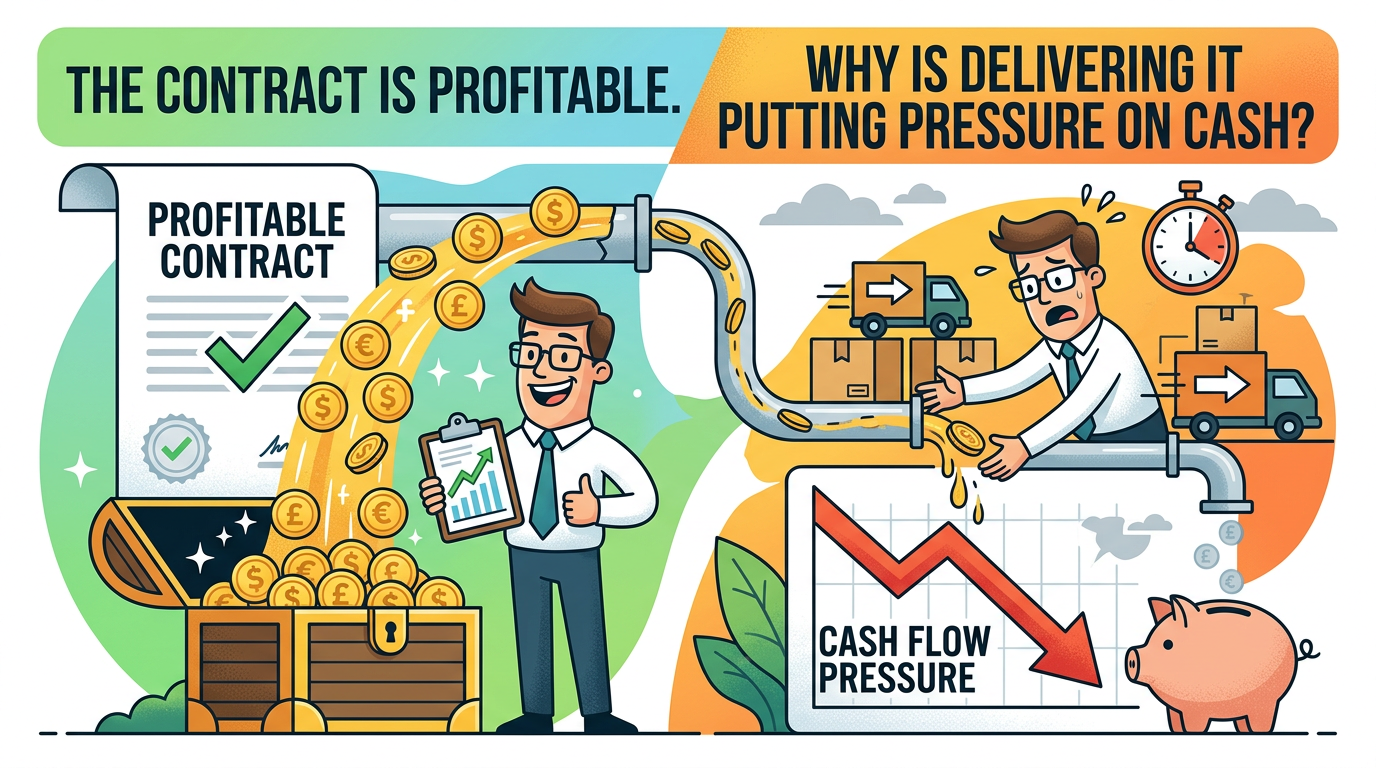
Winning a substantial contract should feel like progress. The customer has accepted the proposal, the expected margin looks healthy, and the team is preparing to deliver. After months of pursuing the opportunity, management finally has something tangible to show for its effort.
Then the payments begin leaving the business. A supplier requires a deposit, employees need to be paid, and additional resources must be secured before work can proceed. The customer’s first substantial payment is still several weeks away.
The owner looks at the contract forecast and sees a profit. The finance team looks at the bank balance and sees pressure. Both assessments can be correct.
For businesses delivering projects, supplying equipment, or providing services over several months, profitability and cash availability follow different timelines. Understanding that difference helps owners assess whether they can deliver a contract comfortably, rather than discovering halfway through that a promising opportunity needs more funding than expected.
Profitability Does Not Explain the Payment Schedule
A contract’s expected profit reflects the relationship between its revenue and the costs attributable to delivering it. That calculation helps management assess whether the work is commercially worthwhile, but it does not explain when customer receipts will arrive.
Cash planning addresses the dates on which money enters and leaves the business. Those dates depend on supplier terms, payroll commitments, customer billing arrangements, and actual collection.
A project may require most of its expenditure before the customer pays a significant portion of the contract price. The final surplus can therefore coexist with a substantial funding requirement during delivery.
Owners need both views before committing resources. A profit estimate answers one commercial question, while a cash forecast shows whether the business can support the route to that result.
A Simple Contract Example Shows the Difference
Consider an illustrative contract worth S$300,000, with expected project costs of S$240,000. On that simplified basis, the project has an expected contribution of S$60,000 before business overheads, financing costs, and tax.
The customer pays S$30,000 at the start, S$120,000 after an agreed milestone, and the final S$150,000 after completion and the contractual payment period. These are cash receipt assumptions, not a schedule for recognising accounting revenue.
Suppose the business must pay S$90,000 for materials and S$70,000 in labour and subcontractor costs before the milestone payment arrives. It has received S$30,000 but paid S$160,000, creating a cumulative project cash shortfall of S$130,000.
If the S$120,000 milestone payment then arrives and the remaining S$80,000 of project costs are paid, the cumulative shortfall becomes S$90,000. The final receipt ultimately produces the expected S$60,000 surplus, assuming all amounts are collected and costs remain as estimated.
The contract can therefore finish with a positive contribution while requiring substantial cash along the way. A business unable to fund that temporary gap may struggle to complete work that appeared attractive when assessed only by margin.
Identify the Largest Funding Gap
The most useful cash question is often how much money the business will need before cumulative customer receipts catch up with cumulative project payments.
Management can estimate this by laying out expected receipts and payments over the delivery period. Weekly intervals may be appropriate where timing is tight, while a less detailed schedule may be sufficient for a smaller or more predictable engagement.
The largest cumulative shortfall indicates the project’s expected peak funding requirement. However, the company must also consider its other commitments and allow for uncertainty rather than treating that figure as a guaranteed maximum.
This approach makes the discussion concrete. Instead of saying that a project “may be tight on cash”, management can identify when pressure is likely to occur, how much funding may be needed, and which assumptions most affect the result.
Upfront Costs Often Arrive Together
The beginning of a contract can concentrate expenditure into a short period. Materials may need to be ordered, temporary facilities arranged, and subcontractors booked before the business can reach its first billable milestone.
Some commitments are also difficult to reverse. Custom-made components may have little resale value, while a subcontractor may require payment for reserved capacity even if the customer delays the project.
Management should identify these commitments before the contract starts. It should understand which amounts become payable immediately, which depend on delivery, and which remain payable if the schedule changes.
A project with modest total costs can still create pressure if those costs are concentrated early. The timing and reversibility of expenditure deserve attention alongside the overall budget.
A Completed Milestone Is Not Always an Immediate Receipt
Project teams may describe a milestone as completed when the operational work is finished. The customer’s payment process may require additional steps before an invoice can be accepted or paid.
There may be a site inspection, written acceptance, a purchase order reference, or supporting documentation to submit. After those requirements are met, the contractual payment period may still need to run.
For example, management might expect cash in June because installation is scheduled for June. If customer acceptance occurs in July and payment follows later, the funding gap lasts longer than the project team initially assumed.
Cash forecasts should therefore distinguish between work completed, billing conditions satisfied, invoice submission, and expected collection. Combining those events into one date can make the outlook appear stronger than it is.
Agree on Practical Billing Arrangements Early
The opportunity to discuss payment structure is usually strongest before the contract is signed. Where commercially feasible, management can seek arrangements that better reflect the costs incurred during delivery.
An initial payment might help cover mobilisation or committed materials. Progress payments could correspond to meaningful stages of work instead of leaving most of the contract value payable at the end.
The proposed structure should be clear and workable for both parties. A milestone is less useful if its completion criteria are ambiguous or require an approval process that nobody has explained.
Changes to agreed terms require agreement with the customer. Once work has started, management should not assume it can solve a funding problem simply by issuing an invoice earlier than the contract permits.
Keep Extra Work From Becoming Unfunded Work
Contracts often evolve during delivery. A customer requests another report, a different specification, or additional installation work. Each change may seem manageable when considered individually.
The financial difficulty arises when the business begins the extra work before agreeing on scope, price, and payment arrangements. Employees spend time and suppliers incur charges, while the related customer payment remains uncertain.
A practical change-control process helps make those commitments visible. The team should record the request, assess its effect on cost and timing, and obtain the necessary agreement before proceeding where possible.
Urgent circumstances may require judgement, but the decision should still be documented. Otherwise, a project can consume additional cash while management continues relying on the original margin estimate.
Update the Cost to Complete
A contract described as profitable at the quotation stage may not remain equally profitable throughout delivery. Overtime, rework, supplier changes, and schedule extensions can alter the expected outcome.
Management should review the remaining cost to complete, alongside amounts already incurred and commitments not yet invoiced. Looking only at invoices received can understate the work and expenditure still ahead.
This distinction is especially important when investigating cash pressure. Some projects need funding because receipts arrive later than payments. Others are also experiencing cost overruns that reduce the expected margin.
The response depends on the cause. A temporary timing gap and a deteriorating commercial position require different decisions, even if both initially appear as a shrinking bank balance.
Examine the Customer’s Actual Payment Behaviour
Contractual terms provide a starting point, but collection expectations should also consider available evidence about the customer’s payment process.
A customer may routinely require invoice corrections, operate specific payment runs, or take longer than expected to resolve approval questions. Previous collection experience can help management form a more realistic forecast.
For a new customer, the team should clarify submission requirements, responsible contacts, and the process for handling disputed items. Where appropriate, commercial credit checks can inform the decision to extend payment terms.
The objective is to understand the exposure before it becomes difficult to manage. A large contract value provides limited comfort if most of the expected cash depends on a payment date that has not been properly assessed.
Plan for the Last Payment to Take Longer
Some contracts leave a significant amount payable after final acceptance, the resolution of outstanding items, or another specified event. Depending on the terms, a retention may also remain unpaid for a further period.
Management should identify these conditions and reflect them in the cash forecast. Physical completion does not necessarily mean every contractual payment is immediately due.
Small unfinished tasks can also have a disproportionate effect when they delay a large final receipt. The project team needs to know which documents, approvals, and completion items remain outstanding.
A clear close-out plan therefore has a financial purpose. It helps the business finish the steps needed to support billing and collection, instead of moving everyone to the next project while the previous one remains financially open.
Combine Project Cash Needs With the Business’s Other Commitments
A contract does not operate in isolation from the rest of the company. The same bank balance may also support existing projects, regular payroll, rent, loan payments, and other obligations.
Two individually manageable contracts can create pressure if their largest funding gaps occur at the same time. Looking at each project separately may conceal the combined requirement.
Management should bring project schedules into a company-wide cash view. This allows it to consider whether new work can begin as planned, whether spending should be phased, or whether additional funding needs to be arranged.
The exercise also prevents cash received for one project from being treated as freely available without considering the remaining cost of delivering that work.
Stress-Test Delays Before They Happen
A cash forecast based entirely on the planned timetable offers limited protection against ordinary disruption. Management should test a small number of plausible changes.
What happens if customer acceptance takes another month? What if a critical supplier requires earlier payment? What if rework postpones completion while labour costs continue?
These scenarios need not become a complex modelling exercise. Their purpose is to reveal which developments would create the greatest pressure and what action would be available.
The team can then agree on early warning points. A delayed approval or an unexpected purchasing commitment should trigger a review while management still has time to respond.
Arrange Funding With a Clear Repayment Basis
Some profitable contracts reasonably require external funding during delivery. The decision should be based on a realistic assessment of the gap, the available terms, and how repayment is expected to occur.
Management needs to understand interest, fees, security requirements, repayment dates, and any conditions attached to the facility. Expected finance costs should also be included when reassessing the contract’s commercial value.
An anticipated facility should not be treated as available cash before approval and relevant conditions are satisfied. Similarly, a repayment plan that depends on one uncertain customer receipt needs careful consideration.
Funding can support an appropriate contract, but it does not resolve unclear billing terms or continuing cost overruns. Those issues still require management attention.
Give Someone Ownership of the Full Picture
Sales, operations, and finance each hold part of the information needed to understand a contract. Sales knows the commercial commitments, operations knows delivery progress, and finance tracks invoices and payments.
Problems arise when these views are not brought together. The sales team may hear that a customer will pay soon, while finance has not received an approved invoice reference. Operations may commit to extra work without knowing how little cash remains before the next receipt.
A regular contract review should connect progress, expected margin, billing readiness, and cash requirements. One person should coordinate unresolved matters and ensure decisions reach the people responsible for acting on them.
This does not require a large meeting every week. It requires the right information to move between teams before assumptions become expensive misunderstandings.
Reliable Reporting Supports Better Contract Decisions
Accurate records help management distinguish between a collection delay, a billing problem, and an increase in delivery costs. They also provide a stronger basis for explaining the situation to directors or an overseas parent company.
Kazuma Public Accounting Corporation provides accounting and bookkeeping services, periodic financial reporting, and parent-company financial reporting support. These services can support the reliable financial information that management needs when reviewing business performance.
Businesses can discuss their reporting requirements with Kazuma, including how existing records support management’s understanding of revenue, expenses, receivables, and obligations. Any additional reporting scope should be agreed according to the company’s needs.
Forecasting future receipts and deciding how to fund delivery remain management responsibilities. Clear historical records and timely reporting make those decisions easier to support.
A Good Contract Needs a Fundable Delivery Plan
A contract’s expected profit is an important measure, but it is only one part of the decision. The business also needs to understand when it must spend money, when it can bill, and when customer payments are likely to arrive.
Before committing to substantial work, examine the peak funding gap, the conditions attached to payments, and the effect of plausible delays. During delivery, keep the cost estimate current and follow through on the steps needed to collect.
For business owners, cash pressure does not automatically mean the contract was a mistake. It may reveal a timing requirement that needs to be planned and funded. The key is to recognise that requirement early, while there is still room to negotiate, prepare, and make informed decisions.