
One AI Project Can Produce One Invoice but Several Different Tax Questions
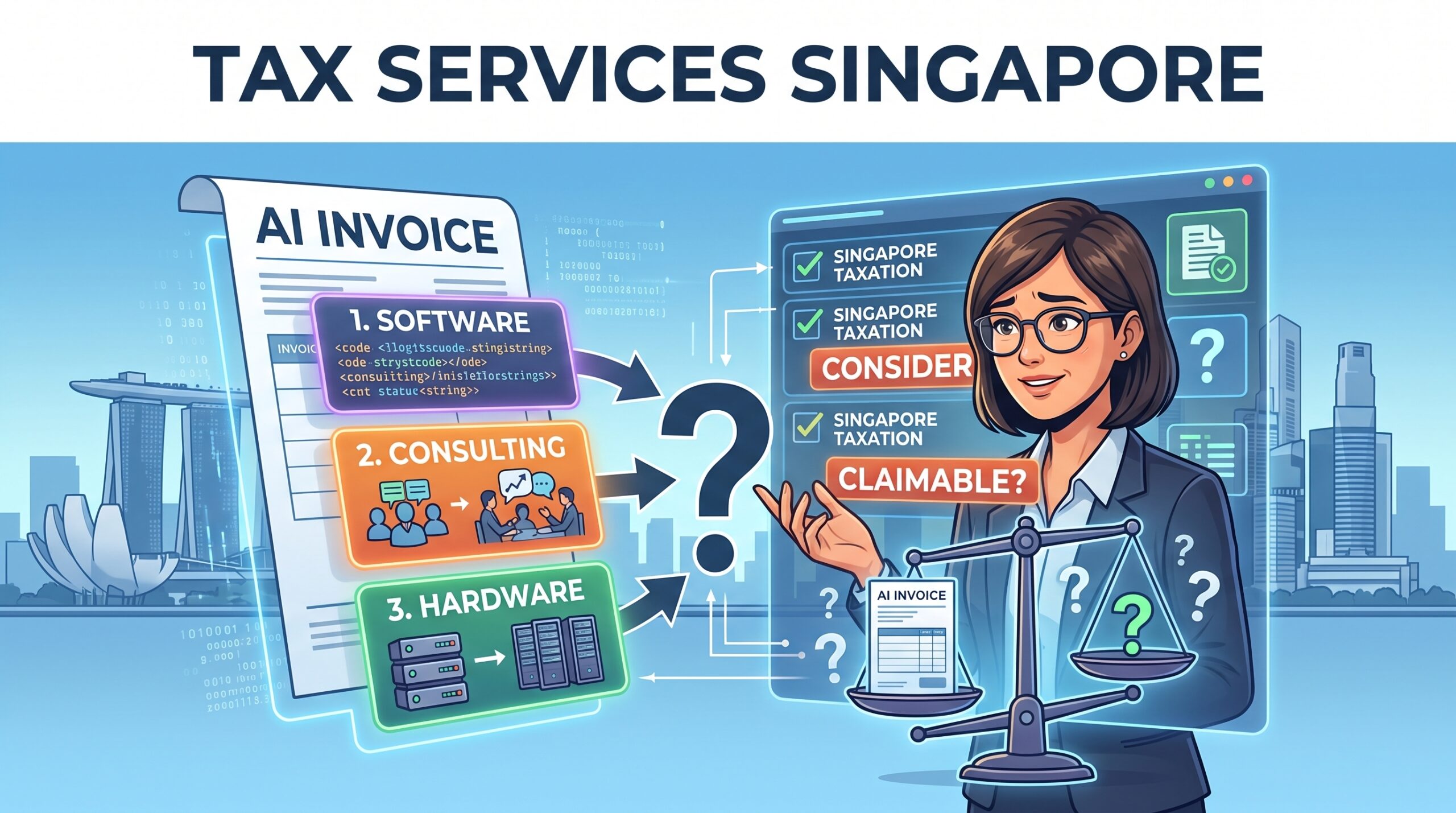
A Singapore company decides that 2027 will be the year it seriously adopts artificial intelligence. Management approves a project to introduce an AI platform across finance, customer service and operations, and the vendor eventually sends an invoice for S$120,000. The invoice includes S$30,000 for AI software subscriptions, S$35,000 for implementation and consulting services, S$15,000 for employee training, and S$40,000 for servers and other computing equipment. To management, this is simply a S$120,000 AI project. From a tax perspective, however, the answer may not be as simple as putting S$120,000 into one category and applying the same treatment to everything. Singapore’s Enterprise Innovation Scheme, or EIS, has been enhanced for Years of Assessment 2027 and 2028 to provide a 400% tax deduction on the first S$50,000 of qualifying AI expenditure per year. The important word is qualifying. What the company purchased, how the expenditure is described, what the services actually involve and whether part of the invoice relates to excluded hardware can all affect the analysis.
Singapore’s New AI Tax Incentive Is Generous but It Is Not Unlimited
The enhanced EIS treatment for AI adoption is significant because qualifying businesses can receive a 400% tax deduction on the first S$50,000 of qualifying AI expenditure per year for YA 2027 and YA 2028. Where qualifying expenditure is ordinarily deductible under Section 14, the 400% comprises the normal 100% base deduction together with an additional 300% deduction. IRAS also provides for the 400% deduction on qualifying AI expenditure that would otherwise not be deductible under Section 14 because of its nature, subject to the conditions of the scheme. For qualifying AI expenditure that is deductible under Section 14 and exceeds S$50,000, the excess can continue to receive the normal 100% base deduction, subject to the usual income tax rules. Businesses considering AI investments should therefore understand that the scheme can be valuable, but it does not mean every dollar associated with an AI project automatically receives four times the tax deduction.
A 400% Deduction Does Not Mean IRAS Pays Four Times What You Spend
The percentage can easily create confusion among business owners. If a company incurs S$50,000 of qualifying AI expenditure and qualifies for the full 400% deduction, this can result in S$200,000 of tax deductions, not S$200,000 being paid to the company. A tax deduction reduces the income subject to tax, so it is fundamentally different from a grant, reimbursement or cash rebate. The actual tax effect depends on the company’s circumstances, including whether it has sufficient taxable income against which the deduction can be utilised and the other rules applicable to the claim. This distinction matters when management prepares an investment proposal. An AI project should make commercial sense based on productivity, revenue, cost reduction, customer experience or another genuine business objective. The tax incentive can improve the economics of a qualifying project, but management should not treat the deduction as though the Government were paying 400% of the project’s purchase price.
Start With What IRAS Actually Defines as Qualifying AI Expenditure
IRAS defines qualifying AI expenditure relatively specifically. It includes expenditure on the subscription to or licensing of an AI system from another person, as well as the subscription to, acquisition or licensing of a qualifying AI business service from another person. An AI system is broadly a machine-based system that infers from inputs how to generate outputs such as predictions, content, recommendations or decisions that can influence physical or virtual environments. IRAS gives examples of capabilities including content generation, reasoning and problem solving, knowledge retrieval, natural language processing, automated planning and optimisation, and multimodal processing. This means businesses should examine what they have genuinely acquired rather than assuming that a product qualifies merely because the vendor places the letters “AI” on its invoice, proposal or marketing material.
The S$30,000 AI Software Subscription May Be the Easiest Part to Understand
Returning to our hypothetical S$120,000 invoice, assume S$30,000 relates to a subscription for an AI system used by employees to analyse business information, generate recommendations and automate selected workflows. If the system meets the relevant definition and the expenditure is incurred for the purpose of the company’s trade or business, this component may fall within qualifying AI expenditure under the EIS rules for YA 2027 or YA 2028. The company would still need to satisfy the applicable conditions and maintain appropriate records, but conceptually this component is much easier to identify than a vaguely described “digital transformation package”. This is why detailed invoices can become valuable. A clear description such as “12-month licence for AI forecasting platform” gives management and its tax services Singapore adviser considerably more information than an invoice containing only “technology project, S$120,000”.
Consulting Can Qualify When It Genuinely Supports AI Adoption
Some businesses may initially assume that only the AI software itself qualifies. IRAS’s definition is broader. A qualifying AI business service can include services provided to support the adoption or development of AI in the business’s trade or business, where the service relates to the development, deployment, operation or maintenance of an AI system. IRAS specifically lists examples including online platforms, system development, consultancy and strategy services, data and analytics services, research and development services, system engineering and compliance services, and system-related training. Therefore, consulting expenditure should not automatically be excluded simply because the company did not purchase software with that portion of the invoice. The key issue is what the consultant actually did and whether those services meet the relevant requirements.
A S$35,000 Consulting Fee Needs More Than the Word “Consulting”
Suppose the S$35,000 implementation and consulting component covers designing AI workflows, configuring the system, integrating it into business processes, preparing data for deployment and developing operating procedures. Those activities may potentially fall within qualifying AI business services. Now imagine instead that half of the consulting fee relates to a general corporate restructuring exercise that would have happened regardless of the AI implementation. Calling the entire amount “AI consulting” would not necessarily make the whole S$35,000 qualifying expenditure. Businesses should look at the actual scope of work, engagement letters, statements of work, project deliverables and vendor invoices. A good tax services Singapore review should start with commercial substance rather than labels. The question should be “What service did we actually receive?” rather than “What description would we prefer to see for tax purposes?”
Training Can Qualify, but the Training Needs to Relate to the AI System
Our hypothetical invoice also contains S$15,000 of training. IRAS includes system-related training among the examples of qualifying AI business services where it is used in relation to the development, deployment, operation or maintenance of an AI system. That creates a potentially important distinction. Training employees to operate, manage or work effectively with the newly deployed AI system may potentially qualify under the AI adoption activity if the relevant conditions are met. A broad leadership seminar about the future of technology may be much harder to connect to the actual development, deployment, operation or maintenance of the AI system. Again, businesses should avoid assuming that everything containing the word “AI” receives identical treatment. The purpose and substance of the expenditure remain important.
Hardware Is Where the Answer Becomes Much Clearer
The S$40,000 of servers and computing equipment creates a different outcome under the AI adoption rules. IRAS expressly excludes expenditure incurred on physical infrastructure or hardware, giving examples such as servers, storage devices and computing equipment. Therefore, the fact that a server is purchased solely to run an AI system does not by itself turn the server into qualifying AI expenditure for this particular 400% AI adoption deduction. The business may need to consider the ordinary tax treatment or other applicable provisions for the hardware separately, but it should not simply combine the server with qualifying AI software and services and claim the entire project cost under the new AI adoption incentive. This is exactly why a S$120,000 “AI project” can produce several tax treatments even though management approved it as one investment.
One Purchase Order Does Not Necessarily Mean One Tax Treatment
Businesses naturally organise spending according to projects, departments and suppliers. Tax rules do not always follow the same categories. Management might approve “Project AI” for S$120,000, create one purchase order and receive one consolidated invoice. That administrative convenience does not necessarily mean every component has the same tax character. The software subscription could potentially qualify as AI expenditure, relevant consulting services could potentially qualify, system-related training could potentially qualify, while hardware is specifically excluded from the AI adoption incentive. Other project costs might fall into still different categories depending on their nature. Companies therefore benefit from obtaining invoices that separately identify major components. The more clearly the commercial documents describe what was purchased, the easier it becomes for finance and tax advisers to determine the appropriate treatment.
Mixed Expenditure Does Not Automatically Destroy the Entire Claim
IRAS has specifically addressed situations where a single expenditure relates partly to qualifying AI expenditure and partly to other expenditure. In such cases, only the portion relating to qualifying AI expenditure qualifies for the enhanced or 400% deduction. If the business cannot obtain evidence identifying the qualifying portion despite reasonable efforts, IRAS states that the expenditure should be apportioned between qualifying AI expenditure and other expenditure on a reasonable basis. This is important because real AI projects are rarely packaged as perfectly separated tax categories. A vendor may charge one implementation fee covering several services. The existence of a mixed invoice therefore does not necessarily mean the company loses the entire potential benefit, but it does mean management needs a defensible method of identifying or reasonably allocating the qualifying amount.
Reasonable Apportionment Should Be More Than Guessing a Percentage
Suppose a S$20,000 bundled implementation fee covers AI configuration and unrelated general IT migration. Management should not simply decide that 90% is AI-related because that produces a larger tax deduction. A reasonable allocation should be supported by available information. The vendor might be able to provide a breakdown based on project phases, employee hours, deliverables or contractual milestones. Internal project records may show which work related specifically to the AI system. Where direct evidence cannot reasonably be obtained, the company should document why the chosen allocation methodology is appropriate. This is where engaging professional tax services Singapore support before filing can be useful. The objective is not merely to maximise the percentage claimed. It is to arrive at a position the business can explain and support if the claim is subsequently reviewed.
Government Funding Can Change the Amount That Qualifies
Another important restriction is that qualifying AI expenditure excludes expenditure subsidised by a grant or subsidy from the Government. This prevents businesses from simply calculating the enhanced deduction on expenditure that has already been subsidised. Imagine a company incurs S$50,000 on a qualifying AI service but receives government support covering part of that expenditure. Management should not automatically assume that the original gross invoice amount is the qualifying figure for the AI deduction. The applicable grant and tax rules need to be considered when determining the claim. This is another reason finance teams should communicate with employees responsible for grants and digital transformation projects. If the tax team sees only the supplier invoice and does not know that another department obtained government funding, it may not have all the information needed to prepare the correct claim.
The AI Adoption Incentive Does Not Offer the EIS Cash Payout Option
The EIS generally contains a cash payout option for certain qualifying activities, subject to eligibility conditions, allowing businesses to convert up to S$100,000 of qualifying expenditure across applicable activities into a non-taxable cash payout at a 20% conversion rate. However, IRAS expressly states that the cash payout option is not available for the new AI adoption activity. This distinction matters particularly for smaller or loss-making companies. Management may hear that EIS has a cash conversion mechanism and incorrectly assume the same choice automatically applies to AI spending. It does not. The AI adoption benefit is structured as a tax deduction for YA 2027 and YA 2028. Businesses evaluating the cash-flow impact of an AI project should therefore avoid building an expected EIS cash payout for AI adoption into their forecasts.
Timing Matters Because the Enhanced AI Treatment Is for YA 2027 and YA 2028
The new AI adoption deduction is available specifically for YA 2027 and YA 2028, so companies planning significant technology projects need to understand how their expenditure falls into the relevant basis period and Year of Assessment. Simply signing a contract or paying a deposit does not necessarily answer every timing question. The nature of the liability, the accounting period and the applicable tax rules need to be considered. This is especially important for projects spanning several years. A company might sign a three-year AI agreement covering software licences, implementation, training and ongoing support. Finance should understand when the expenditure is incurred for tax purposes and how the applicable caps operate rather than waiting until the tax return is prepared months later. Early involvement by finance and tax professionals can make the documentation and analysis considerably easier.
The S$50,000 Cap Makes Classification Commercially Important
Consider again the S$120,000 project. If S$30,000 of software, S$35,000 of qualifying consulting and S$15,000 of qualifying system-related training satisfy the requirements, the company could potentially have S$80,000 of qualifying AI expenditure before considering any other adjustments. The enhanced AI deduction, however, applies to the first S$50,000 of qualifying AI expenditure per year. For qualifying expenditure that is deductible under Section 14, amounts above S$50,000 can continue to receive the normal 100% base deduction, subject to the general rules. The S$40,000 hardware portion remains outside the AI adoption incentive. This example demonstrates why the headline project value is not the figure management should automatically use. The tax computation needs to move from total project cost to qualifying expenditure and then apply the relevant cap and treatment.
S$50,000 of Qualifying Expenditure Could Produce S$200,000 of Deduction
Using a simplified example, suppose the company identifies exactly S$50,000 of expenditure that fully qualifies for the new AI adoption treatment. A 400% deduction would correspond to S$200,000 of deductions. If the same qualifying expenditure would ordinarily have received a 100% deduction, the enhanced benefit effectively includes an additional 300% deduction under the EIS framework. However, management should be careful when converting that deduction into an estimated cash saving because the final tax outcome depends on the company’s taxable position and applicable rules. A deduction is valuable only within the context of the tax computation. This is why professional tax services Singapore advice should explain not merely the amount that can potentially be deducted but what that deduction means for the company’s actual tax position.
A Loss-Making Company Should Not Assume the Benefit Works Like a Grant
A profitable company may immediately see how an additional deduction could reduce taxable income. A company making tax losses may view the incentive differently because there may not be current taxable income against which the deduction produces an immediate reduction in tax payable. The relevant treatment of losses and their future utilisation will depend on applicable tax rules and the company’s circumstances. Since the EIS cash payout option does not apply to AI adoption, a loss-making business should be particularly careful not to interpret the 400% deduction as immediate government funding. This does not make the incentive irrelevant, but it changes the financial analysis. Management should distinguish between accounting cost, cash paid to the vendor, tax deductions generated and when any resulting tax benefit may actually be realised.
Vendor Marketing Should Not Determine Your Tax Claim
As the incentive becomes better known, businesses are likely to encounter vendors promoting products as “EIS eligible”, “400% deductible” or similar. Such statements may be useful indicators, but the company making the tax claim remains responsible for ensuring the relevant conditions are satisfied. A vendor may sell a package containing qualifying software together with excluded hardware and unrelated services. The fact that the overall package is marketed as an AI solution does not override the detailed rules. Management should obtain sufficient information about the product and service components and seek advice where the position is unclear. Tax incentives are most useful when businesses understand them before entering a contract, rather than discovering during tax filing that the commercial invoice does not provide enough information to support the intended claim.
Better Invoices Can Make Better Tax Documentation
A company negotiating an AI implementation should consider documentation before the project begins. Instead of accepting a one-line S$120,000 invoice for “AI transformation services”, management can ask the supplier to separately describe software licences, implementation services, system development, data work, training, hardware and other significant components. This does not change the economic substance of the transaction, nor should descriptions be manipulated simply to obtain a tax advantage. It does, however, create a clearer record of what the business genuinely purchased. Contracts, proposals, statements of work, project schedules and acceptance documents can further support the analysis. Good documentation is especially valuable when a project contains mixed qualifying and non-qualifying expenditure and an allocation needs to be supported several months later during corporate tax preparation.
Finance Should Be Involved Before the AI Contract Is Signed
Technology projects are often led by IT, operations or business transformation teams, with finance becoming involved only when the supplier asks for payment. That approach can create unnecessary tax and documentation problems. If finance understands the project before the contract is signed, it can identify whether the agreement bundles software, consulting, training and hardware into one price, whether government funding is involved and whether clearer cost breakdowns should be requested. The tax team can also consider the timing of expenditure and applicable EIS requirements. This does not mean tax should dictate the company’s technology strategy. The business should still choose the AI solution that creates the strongest commercial value. However, involving finance early helps ensure that legitimate tax benefits are not lost simply because nobody considered documentation until the corporate tax return was due.
Head Office and Singapore Finance Need to Coordinate on Regional AI Projects
This issue can be particularly relevant for multinational companies, including Japanese groups operating through Singapore subsidiaries. A parent company may negotiate a regional AI contract covering Japan, Singapore and several ASEAN markets, while the Singapore entity is allocated part of the cost. The local finance team then needs to understand what Singapore actually received, how the cost was allocated, whether the expenditure relates to qualifying AI systems or services and whether hardware or other non-qualifying components are included. A simple intercompany recharge labelled “regional AI project” may not provide enough information by itself to analyse the local tax treatment. Businesses using tax services Singapore support should therefore make sure their advisers can access the underlying agreements and allocation methodology rather than providing only the final recharge invoice.
AI Tax Planning Should Not Become AI Spending for the Sake of Tax
A generous deduction can sometimes encourage management to focus on the tax benefit rather than the commercial purpose. That reverses the correct order of decision-making. A company should not spend S$50,000 on an unnecessary AI tool merely because the expenditure could potentially receive enhanced tax treatment. Even a valuable tax deduction does not eliminate the underlying cash outflow, implementation effort, employee training requirements or risk that the system fails to produce meaningful business benefits. The strongest investment case starts with a genuine business problem, identifies an appropriate AI solution, evaluates expected returns and then considers available tax incentives as part of the overall economics. Good tax planning improves a sensible business decision. It should not be used to justify an investment that management would otherwise reject.
Tax Services Singapore Can Help Separate the Project Into the Right Components
For a business undertaking a substantial AI investment, professional tax support can help management move beyond the headline invoice and understand the individual components. Kazuma Public Accounting Corporation provides corporate tax compliance and advisory support in Singapore, including services for local businesses and multinational companies. A proper review may involve examining software subscriptions, consulting scopes, implementation services, training, hardware, government subsidies, intercompany recharges and the timing of expenditure. The objective should be to identify the appropriate tax treatment based on the actual transaction while maintaining documentation that supports the company’s position. For multinational businesses in particular, this analysis can also help local finance teams communicate clearly with overseas head offices about why Singapore tax treatment may not follow the way the project was grouped in the global procurement system.
The Best Time to Ask What Qualifies Is Before You Receive the Final Invoice
Businesses planning AI investments for the relevant periods should not wait until corporate tax filing to ask whether the expenditure qualifies. By that stage, the project team may have moved on, consultants may have completed their engagement and the employee who negotiated the contract may no longer remember why particular charges were bundled together. Reviewing the structure earlier gives the business an opportunity to obtain detailed proposals, clarify deliverables and maintain records while the information is readily available. It also allows management to understand the potential tax benefit when evaluating the project’s financial return. This is not about designing artificial transactions purely to obtain a deduction. It is about making sure the documentation accurately reflects a genuine AI investment and provides enough detail for the tax treatment to be determined properly.
One AI Invoice Can Contain Several Completely Different Answers
The central lesson is simple: an AI project is not automatically one tax category. A S$120,000 invoice might contain an AI software subscription that potentially qualifies, implementation and consulting services that potentially qualify, system-related training that may qualify, and S$40,000 of servers that IRAS specifically excludes from qualifying AI expenditure. A government subsidy can affect the amount considered, while mixed expenditure may require a reasonable apportionment. The S$50,000 annual cap then applies to qualifying AI expenditure for the enhanced treatment, and the EIS cash payout option is unavailable for AI adoption. Businesses therefore need to understand the components rather than applying “400%” to the number printed at the bottom of the vendor’s invoice.
Strong Tax Planning Begins With Understanding What the Business Actually Bought
Singapore’s enhanced EIS treatment gives businesses a meaningful incentive to adopt AI during YA 2027 and YA 2028, but the value of the incentive depends on understanding the rules and maintaining appropriate evidence. Software, consulting, data services, engineering and system-related training can potentially fall within qualifying expenditure when the relevant requirements are satisfied, while physical infrastructure and hardware such as servers, storage devices and computing equipment are expressly excluded. Mixed projects need to be analysed carefully rather than treated as all-or-nothing claims. For companies investing heavily in digital transformation, this makes tax planning part of project planning rather than an exercise performed after the technology has already been purchased.
The Question Is Not “Is This an AI Project?” but “What Exactly Did We Pay For?”
When management receives a large AI invoice, the most useful question is not whether the overall project uses artificial intelligence. The better question is what each dollar actually purchased. That distinction can separate qualifying software from excluded hardware, qualifying implementation support from unrelated consulting, and system-related training from broader expenditure. As Singapore encourages businesses to adopt AI, companies have an opportunity to combine technological investment with legitimate tax incentives, but only where the expenditure satisfies the relevant requirements. Businesses that understand the transaction before signing the contract, document it properly during implementation and review the components carefully with their tax services Singapore adviser will be in a much stronger position to claim the benefits available while avoiding the assumption that everything carrying an AI label automatically receives the same tax treatment.