
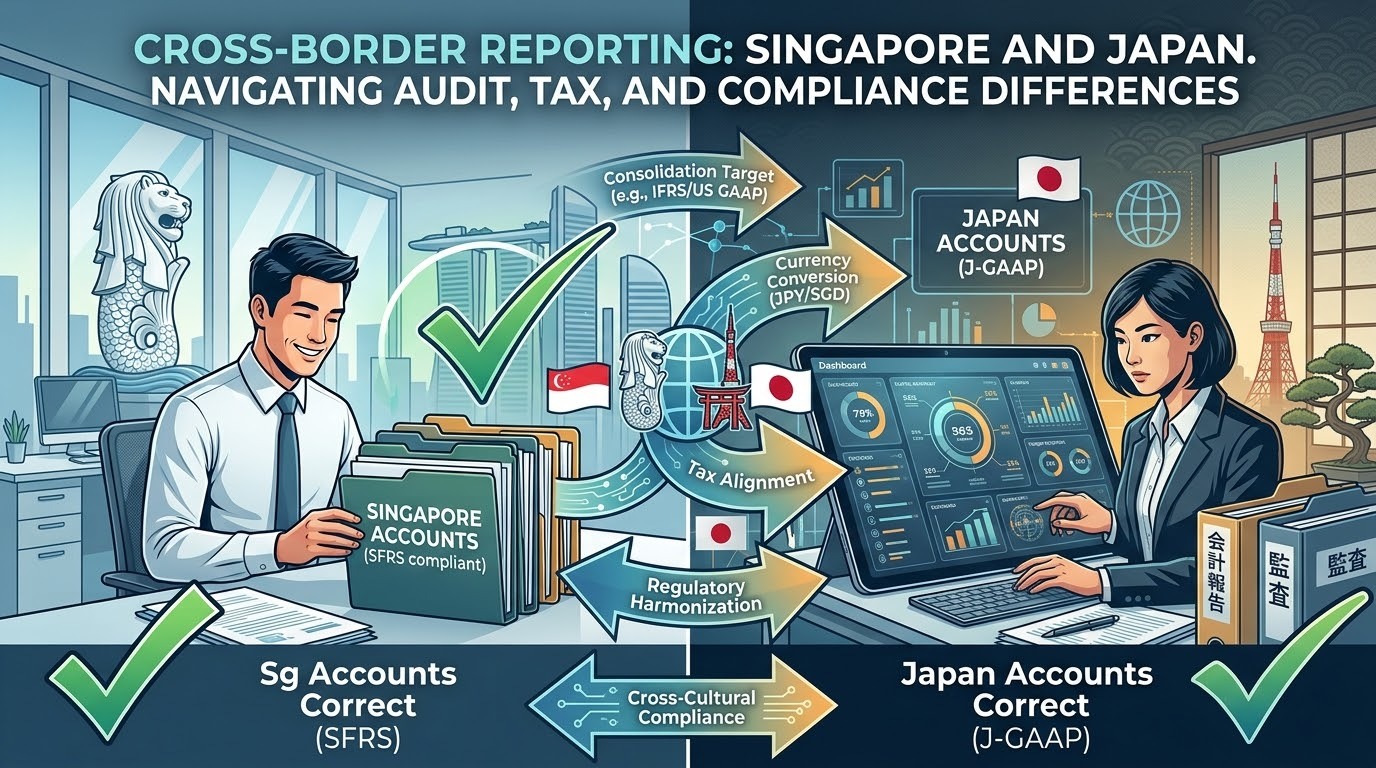
The Singapore Finance Team Has Finished, but Head Office Says the Work Is Not Done
Imagine a Singapore subsidiary reaches the end of its financial reporting period. The finance team has completed the accounts, reconciled the bank balances, reviewed receivables and payables, calculated depreciation, recorded accruals and prepared financial information in accordance with the requirements applicable to the Singapore entity. Management is satisfied with the numbers and the local accounting team believes the reporting process is complete. Then an email arrives from the parent company overseas asking for a separate consolidation package, additional schedules, different account classifications and several adjustments. For the Singapore team, the reaction is understandable: if the local accounts are already correct, why does head office need another set of numbers? The answer is that local financial reporting and group reporting serve different purposes. A Singapore subsidiary can have properly prepared local accounts while its parent company still requires information to be reorganised, supplemented or adjusted before those numbers can be incorporated into the group’s consolidated financial statements.
“Correct” Depends on What the Financial Information Is Being Used For
When people describe accounts as correct, they sometimes assume there can only be one acceptable presentation of financial information. In reality, financial information can be prepared for different reporting purposes. The Singapore subsidiary has obligations relating to its own accounting records, statutory financial statements, tax matters and other local requirements. The parent company, meanwhile, is trying to produce financial information for an entire corporate group that may operate across several countries. That group may have its own accounting policies, reporting formats, materiality considerations, chart of accounts and consolidation procedures. The parent is therefore not necessarily saying the Singapore finance team made a mistake. It may simply be saying that locally prepared information needs to be translated into the format and accounting framework required for group reporting. This distinction is particularly important for multinational businesses using Singapore audit services, because local statutory reporting and parent-company reporting can run alongside each other while serving different stakeholders.
A Parent Company Cannot Simply Add Every Subsidiary’s Accounts Together
Consider a multinational group with subsidiaries in Singapore, Japan, Malaysia, Thailand, Indonesia and Australia. Each entity keeps accounting records for its own operations, but the parent company ultimately needs to present the group as one economic organisation. It cannot simply take the profit from every subsidiary, add the figures together and call the result consolidated profit. The group may need to eliminate transactions between related companies, align accounting policies, translate foreign currencies, account for acquisitions and ensure similar transactions are treated consistently across different entities. ACRA’s guidance for group financial reporting highlights matters such as consistent accounting policies across group companies, significant subsidiary transactions and the proper reflection of subsidiary information in consolidated financial statements. This is why a parent company often asks its subsidiaries to complete structured reporting packages rather than simply emailing a copy of their local financial statements.
The Reporting Package Is a Bridge Between Singapore and the Group
A consolidation reporting package can be thought of as a bridge. On one side sits the Singapore entity’s local accounting information. On the other side sits the parent company’s consolidated reporting process. The package helps transform the subsidiary’s financial information into a format that can be consistently combined with information from other entities. It may include a trial balance mapped to the group’s chart of accounts, information about intercompany transactions, related-party balances, fixed assets, provisions, tax, leases, commitments and other schedules requested by the parent or group auditor. Kazuma Public Accounting Corporation specifically describes consolidation packages as financial and management reports required when a parent company consolidates its Singapore subsidiary and provides support for their preparation. The package therefore is not evidence that the local accounts failed. It is part of making those local numbers usable at group level.
The Parent Company’s Chart of Accounts May Look Completely Different
One practical source of confusion is account mapping. A Singapore subsidiary may record expenses using detailed local accounts such as transportation, employee welfare, professional fees, software subscriptions and administrative expenses. The parent company’s consolidation system may use a different chart of accounts and require those balances to be mapped into specific group categories. The total expenses can remain exactly the same while the classification used for group reporting changes. Problems arise when mapping is performed inconsistently from one period to another or when one local account contains several types of expenditure that the group expects to see separately. A well-prepared reporting package therefore requires more than copying the Singapore trial balance into a spreadsheet. Someone must understand what the local balances represent and where they belong within the group’s reporting structure.
Different Accounting Policies Can Require Group Adjustments
Another reason the parent company may request adjustments is the need for consistent accounting policies across the consolidated group. A Singapore subsidiary may have prepared its accounts appropriately for its local reporting requirements, while the parent company applies group accounting policies that require certain items to be treated or presented differently for consolidation purposes. ACRA’s audit regulatory guidance specifically recognises that component financial information may need adjustments in group financial statements because of differences in financial reporting frameworks, accounting policies or financial periods. This does not automatically mean either set of accounts is wrong. The local accounts answer the reporting requirements of the Singapore company, while the consolidation adjustments help the parent present the group consistently.
Depreciation Is a Simple Example of How Differences Can Appear
Imagine the Singapore subsidiary owns equipment with a carrying amount based on the accounting estimates applied locally. Head office may maintain group-wide accounting policies or reporting instructions that require particular asset categories to be reviewed or presented consistently across all subsidiaries. The Singapore figure may therefore be acceptable for the subsidiary’s reporting while an adjustment is required in the consolidation package to align the information with group requirements. Similar situations can arise around provisions, leases, impairment, employee benefits, revenue recognition and other accounting areas. The important point is that an adjustment requested by head office should not immediately be interpreted as a correction of an error. Finance teams should understand whether it is a local accounting correction, a group reporting adjustment or simply a reclassification for consolidation purposes.
One Transaction Can Look Very Different From the Group’s Perspective
Suppose the Singapore subsidiary sells S$1 million of goods to its parent company. From the Singapore entity’s perspective, this may represent revenue arising from a genuine transaction. The parent company records the corresponding purchase. If someone simply adds both companies’ accounts together, however, the group would appear to have generated revenue from selling goods to itself. Consolidated financial statements generally need to reflect the group as a single economic entity, which means intercompany transactions and balances require appropriate elimination. The local transaction can therefore be properly recorded in Singapore while disappearing or being adjusted during consolidation. This is one of the clearest examples of how the same transaction can be correct at entity level but require different treatment at group level.
Intercompany Balances Must Agree Before They Can Disappear
Intercompany elimination sounds straightforward until two subsidiaries report different numbers. Singapore says it owes the parent S$980,000. Head office says Singapore owes S$1 million. Perhaps one entity recorded a payment before the other, an invoice was posted in different periods, foreign exchange treatment differs or a credit note has not reached both accounting systems. Before the group can eliminate the balance, somebody needs to understand the S$20,000 difference. This is why parent companies frequently ask subsidiaries to submit detailed intercompany schedules and confirm balances with other group entities. The objective is not merely to create more administrative work. Unresolved intercompany differences can delay consolidation and create questions for group management and auditors, particularly when numerous subsidiaries are involved.
Different Currencies Create Another Reporting Layer
A Singapore subsidiary may keep its books and prepare its financial information in Singapore dollars while its Japanese parent reports group results in Japanese yen. Another subsidiary may use Malaysian ringgit, while another operates in US dollars. The group therefore needs a consistent process for translating financial information into its reporting currency. This can involve different exchange rates for different elements of the financial statements and may generate translation differences. The Singapore accounts do not become incorrect simply because the parent company needs the figures in another currency. Currency translation is another stage required to turn entity-level information into group-level financial information.
Different Financial Year Ends Can Complicate the Picture Further
Not every multinational group begins with perfectly aligned reporting calendars. A Singapore subsidiary may have historical reporting arrangements that differ from those of its parent, or a newly acquired entity may initially operate on another financial year-end. Group reporting requirements may therefore require additional financial information covering specific periods or adjustments necessary to align reporting. Singapore’s framework places the treatment of parent and subsidiary financial year alignment within applicable financial reporting standards. From the finance team’s perspective, this can mean producing information that does not correspond exactly with the subsidiary’s normal annual reporting cycle. The local accounts may still be correct for their purpose, but the group needs information covering the period relevant to consolidation.
Head Office May Need More Detail Than Local Financial Statements Show
Statutory financial statements are designed to meet financial reporting requirements, not to answer every management question a parent company may have. Head office might want revenue broken down by product, geography or business segment. It may require employee costs divided into categories, detailed capital expenditure schedules, related-party information, tax-effect accounting, ageing analyses or explanations for significant movements. Kazuma’s accounting services specifically include monthly, quarterly and other periodic reporting to management, directors and parent companies, together with parent-company financial reporting support. A reporting package can therefore contain substantially more operational and accounting detail than the subsidiary’s statutory financial statements, even though both ultimately originate from the same underlying accounting records.
Materiality Can Be Different for Singapore and for the Group
A transaction that appears significant to a Singapore subsidiary may be relatively small from the perspective of a multinational group, while another item can become important because of its nature or because similar amounts appear across many subsidiaries. Group auditors and management therefore cannot necessarily apply the Singapore entity’s perspective to every reporting decision. ACRA’s regulatory guidance notes that group auditors determine group and component materiality as part of planning and must communicate the required scope and procedures to component auditors. This helps explain why the parent or group auditor may request additional work in one area while appearing less interested in another balance that local management considers more important.
The Group Auditor May Ask Questions the Local Auditor Did Not Ask
This is another source of frustration for finance teams. The Singapore statutory audit is progressing well, and the local auditor has already examined a particular balance. Then the group auditor sends a separate instruction asking for additional information about the same area. The natural response is: “Wasn’t this already audited?” However, the group auditor is responsible for obtaining sufficient appropriate audit evidence to support the group audit opinion and may require component auditors to perform work designed specifically around group-level risks. ACRA notes that the group auditor’s responsibilities include directing and supervising component auditors and reviewing their work, and further procedures may be necessary when the evidence obtained is not sufficient for group purposes. The second request therefore does not necessarily mean the first audit was inadequate. The two engagements may be addressing different reporting objectives and risks.
A Local Audit Report Does Not Automatically Replace a Consolidation Package Audit
A Singapore subsidiary may already have statutory audited financial statements, but the parent company may still request assurance over its consolidation reporting package. Kazuma explains that parent-company consolidation package audits are non-statutory engagements used to support preparation of consolidated financial statements and that their scope can be customised according to parent-company or group-auditor requirements. This distinction matters because the information submitted for consolidation may not be identical to the subsidiary’s statutory financial statements. If the parent relies on particular schedules, adjustments or group reporting fields, it may want assurance over that information specifically rather than assuming the local statutory audit automatically covers every item in the package.
“But We Already Sent the Audited Accounts” May Not Solve the Problem
Imagine head office asks Singapore for a detailed reporting package containing 50 fields and supporting schedules. Singapore replies by sending a PDF of its audited financial statements. The document may be completely accurate and independently audited, yet head office still cannot directly upload it into the consolidation system. It may not contain the required account mapping, intercompany details, group adjustments or management information. This is why finance teams should understand what the parent is requesting before assuming existing reports are interchangeable. Sending more documents is not always the same as sending the right information.
Group Reporting Deadlines Can Be Earlier Than Singapore Deadlines
Multinational groups often operate under tight reporting calendars because information from many subsidiaries must be collected, reviewed, adjusted and consolidated before the parent can complete its own reporting. The Singapore subsidiary may therefore receive a head-office deadline that feels surprisingly early compared with its local statutory timetable. Waiting until local financial statements are completely finalised before beginning the group package may create unnecessary pressure. Kazuma specifically supports head-office reporting timelines and group audit deliverables as part of its audit and accounting services. For finance teams, the practical lesson is that local reporting and group reporting should be planned together rather than treated as two completely separate projects.
Late Adjustments Create Problems Far Beyond Singapore
A S$100,000 adjustment identified in Singapore may be relatively easy to post locally. At group level, however, that adjustment may affect consolidation entries, intercompany eliminations, tax calculations, management reporting and other schedules that have already been prepared. If the parent has dozens of subsidiaries, repeated late changes can create substantial additional work. This is why head office may appear unusually strict about reporting deadlines, cut-off procedures and the finalisation of numbers. The Singapore team sees one adjustment; group finance sees a change that may need to flow through several layers of reporting.
Clear Reconciliation Between Local and Group Numbers Is Essential
When a reporting package differs from the Singapore statutory accounts, finance should be able to explain why. A clear reconciliation can show the local trial balance, reclassifications, group reporting adjustments and final amounts submitted to head office. Without that bridge, employees may struggle months later to understand why the figure reported to Tokyo differs from the figure in the Singapore financial statements. This becomes particularly important when staff change, auditors ask questions or head office challenges a movement in the following period. Good documentation prevents the group reporting process from becoming dependent on one employee remembering what happened.
Repeating Manual Adjustments Every Month Is a Warning Sign
Some group adjustments are unavoidable, but recurring manual adjustments deserve attention. If Singapore finance performs the same twenty reclassifications every month because its local chart of accounts does not map cleanly to the parent company’s reporting structure, there may be an opportunity to improve the process. The company could refine account mapping, redesign reports or configure systems to produce the required information more efficiently. A reporting package should not become an elaborate monthly exercise in repairing information that could have been structured correctly earlier. As reporting volumes increase, reducing unnecessary manual intervention can improve both speed and consistency.
Different Systems Do Not Have to Mean Different Truths
A Singapore subsidiary may use Xero, QuickBooks, MYOB or another accounting platform while the parent company operates a completely different enterprise system. Kazuma notes that it can work with common accounting software as well as systems required by parent companies. Different systems can make reporting more complicated, but the underlying financial information should remain reconcilable. The challenge is establishing reliable mapping, cut-off procedures and controls so that data moving from the Singapore system into the group reporting environment remains complete and understandable. Technology should support the reporting process rather than create a second version of the truth.
The Parent Company’s Questions Can Actually Improve Local Reporting
Although repeated questions from head office can feel burdensome, they sometimes expose weaknesses that are useful for the Singapore subsidiary to address. Perhaps intercompany balances are regularly reconciled too late. Maybe certain accounts contain a mixture of transactions that should be separated. Perhaps fixed asset information is difficult to produce or explanations for month-to-month movements depend on one employee’s knowledge. Group reporting requests can therefore reveal where local financial information could become more structured. The goal should not be to comply with every request mechanically but to identify whether recurring questions point to an opportunity for better processes.
Singapore Audit Services Become More Complex in Multinational Groups
For a standalone Singapore SME, the annual reporting process may revolve mainly around local accounting, tax and statutory obligations. A subsidiary of a multinational group can face an additional layer of expectations from its parent company and group auditors. Local accounts, consolidation packages, group accounting policies, intercompany reconciliations and group audit instructions may all operate simultaneously. This is where Singapore audit services require an understanding not only of local statutory reporting but also of how a Singapore entity fits into a broader corporate group. The finance team must be able to communicate in both directions, explaining Singapore information to head office while translating group requirements into practical actions locally.
Kazuma Public Accounting Corporation Supports Both Sides of the Reporting Process
Kazuma Public Accounting Corporation is particularly relevant to businesses facing this situation because its services are designed for both SMEs and multinational corporations operating in Singapore. Kazuma provides statutory audits, financial statement audits, head-office reporting, parent-company consolidation package audits, group audit and consolidation support, and assistance when audits are conducted by parent-company-appointed external auditors. Its accounting services also include parent-company financial reporting support and consolidation package preparation. This combination is useful when a Singapore subsidiary needs to satisfy local requirements while also responding efficiently to the reporting expectations of an overseas parent company.
Japanese Parent Companies Can Create a Particularly Important Reporting Relationship
For Singapore subsidiaries of Japanese companies, communication between local finance and head office can involve more than simply sending numbers overseas. The parent may have detailed group reporting formats, internal deadlines, accounting instructions and audit requirements that must be understood locally. Kazuma specifically highlights its experience supporting Japanese companies in Singapore with parent-company reporting, consolidation packages and communication with parent companies in Japan. The value of this support is not that Singapore accounting rules somehow become Japanese accounting rules. Rather, it is about helping the local subsidiary maintain appropriate Singapore reporting while preparing the additional information required for the parent’s consolidated reporting process.
Good Group Reporting Starts Before the Reporting Package Arrives
The worst time to discover a complicated group reporting requirement is the night before the submission deadline. Singapore subsidiaries can improve the process by understanding head-office instructions early, maintaining clear account mapping, reconciling intercompany balances regularly and identifying recurring group adjustments throughout the year. Finance teams should also know which schedules require information from departments outside finance so that data collection does not begin at the last minute. When group reporting is treated as an ongoing process rather than a quarterly spreadsheet emergency, both Singapore management and head office receive better information with less unnecessary pressure.
Management Should Know Which Number It Is Looking At
A multinational subsidiary can sometimes have several legitimate versions of a financial figure in circulation. There may be the local management number, the statutory financial statement amount and the group reporting amount after consolidation adjustments. Problems occur when employees compare those figures without understanding what each represents. Management should therefore ensure that reports are clearly labelled and reconcilable. If Singapore reports S$5 million of profit locally while head office shows a different amount for consolidation purposes, the difference should be explainable rather than mysterious. Good financial reporting is not about forcing every report to display exactly the same figure. It is about ensuring every figure has a clear purpose and can be reconciled to reliable underlying records.
An Adjustment Does Not Automatically Mean Someone Was Wrong
This is perhaps the most important lesson for finance teams. When head office asks for a group adjustment, the conversation should not immediately become a debate over whether Singapore or the parent company is correct. The first question should be what the adjustment is intended to achieve. Is it correcting a local accounting error? Is it aligning the subsidiary with a group accounting policy? Is it eliminating an intercompany transaction? Is it translating information into the group reporting currency? Is it a reclassification required by the consolidation package? Once the purpose is understood, it becomes much easier to determine whether the local books themselves should change or whether the adjustment belongs only within group reporting.
The Goal Is One Reliable Story Told at Different Reporting Levels
Local reporting and group reporting should ultimately describe the same underlying business, even though they may present certain information differently. Singapore management needs reliable information about the subsidiary. The parent company needs reliable information about the entire group. Auditors need sufficient appropriate evidence relevant to their respective engagements. Regulators and other stakeholders may have additional requirements. The reporting package exists to connect these perspectives. If the process is well controlled, every adjustment can be explained, every major difference can be reconciled and head office can understand how the Singapore subsidiary contributes to the consolidated group.
Conclusion: Correct Singapore Accounts Can Still Need a Different Reporting Package
When a Singapore subsidiary has completed accurate local accounts and the parent company requests another reporting package, the request should not automatically be interpreted as duplication or criticism of the local finance team. Consolidated reporting requires the parent to combine numerous businesses into one coherent financial picture. That can require account mapping, consistent accounting policies, intercompany eliminations, currency translation, additional disclosures, group adjustments and information that does not appear in the subsidiary’s statutory financial statements. ACRA’s guidance on group audits similarly recognises the importance of group-level accounting and reporting matters and the need to consider adjustments arising from differences in frameworks, policies and financial periods. The Singapore accounts can therefore be correct while the parent company’s reporting package is also necessary.
Kazuma Helps Singapore Subsidiaries Connect Local Reporting With Head Office
For multinational companies seeking Singapore audit services, the challenge is often not simply producing accurate local accounts. It is ensuring that those accounts can also support the reporting, consolidation and audit requirements of the wider group. Kazuma Public Accounting Corporation supports this connection through statutory and financial statement audits, parent-company consolidation package audits, head-office reporting, group audit support and accounting services for Singapore subsidiaries of multinational companies. When local finance understands what head office needs and head office can rely on information coming from Singapore, the reporting package stops looking like a second unnecessary set of accounts. It becomes what it was intended to be: a reliable bridge between one correctly reported Singapore business and the consolidated financial picture of the entire group.