
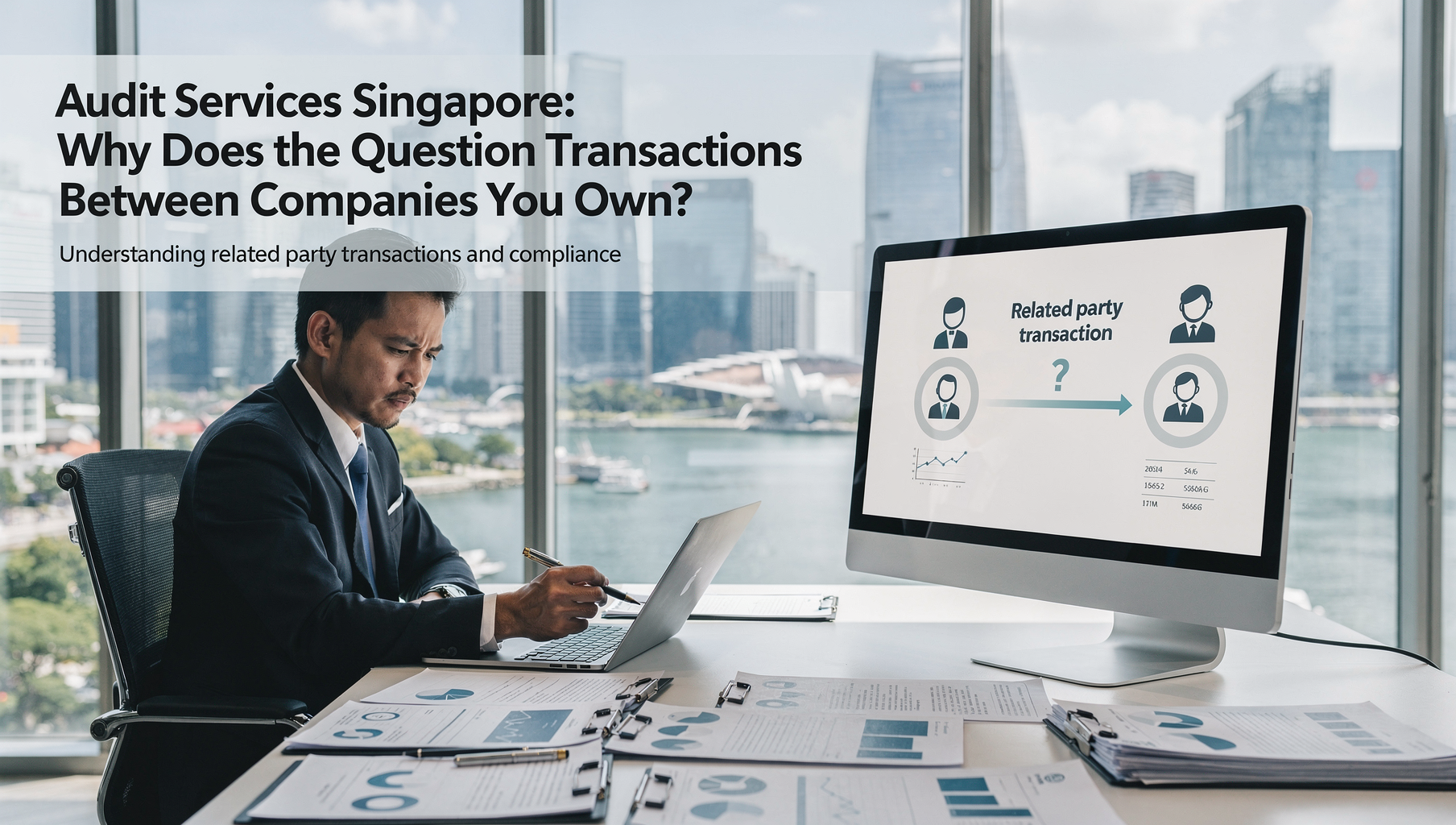
You own two companies. One has available cash, while the other needs help paying a supplier. You arrange a transfer, both businesses continue operating, and the finance team records the movement. From your perspective, it is a practical decision between businesses you control.
Months later, the auditor asks questions. What was the payment for? Was it a loan or reimbursement? Who approved it? When will it be repaid? Are there other transactions between the companies that have not been identified?
For an owner, these questions can feel unnecessary when the commercial explanation seems obvious. However, common ownership does not make the financial consequences of a transaction disappear. Each company’s records need to explain what happened and how the arrangement affects its financial position.
For businesses researching Audit Services Singapore, related-party transactions are an important area to understand. Knowing why auditors examine them can help management prepare clearer records, address questions earlier, and avoid relying on explanations that only make sense to the owner.
Common Ownership Does Not Make the Accounts Interchangeable
Owners often think about several businesses as one overall enterprise. The companies may share a brand, an office, or a management team, making transfers between them feel like movements within the same operation.
However, the accounts of an individual company need to reflect that company’s transactions and obligations. A payment made by Company A for Company B requires an explanation in both sets of records, even if the same person ultimately controls them.
Imagine Company A pays S$30,000 for equipment delivered to Company B. The payment record alone does not establish whether Company A bought an asset, advanced money, or settled an amount it already owed. The underlying arrangement determines what the finance teams need to record.
That distinction matters to anyone relying on the accounts. An owner may understand the wider commercial intention, but the financial records must make the position understandable to someone who was not involved in the decision.
What Makes a Transaction a Related-Party Transaction?
Related-party relationships extend beyond a parent company and its subsidiaries. Depending on the applicable reporting framework, they can include entities under common control, certain relationships involving key management personnel, and relevant close family relationships.
A related-party transaction can involve resources, services, or obligations, even when no price is charged. Loans, service arrangements, asset transfers, guarantees, and payments made on another entity’s behalf may therefore require consideration.
Management should assess relationships using the applicable accounting definition rather than assuming that every familiar business contact is related. Equally, a company should not be left off the assessment simply because it trades under a different name.
A useful starting point is a current list of potentially relevant people and entities, with an explanation of the relationships. This allows the accounting team to assess the position systematically rather than discovering connections only when the audit begins.
Why Audit Services Singapore Includes Questions About Related Parties
Related-party transactions are a normal part of business. Their existence does not, by itself, suggest wrongdoing or mean that every transaction carries unusually high risk.
Nevertheless, relationships can affect how arrangements are negotiated, approved, and recorded. An owner may allow one company to delay repayment indefinitely or arrange a service charge without the documentation normally requested from an outside supplier.
Under Singapore Standard on Auditing 550, auditors consider related-party relationships and transactions when assessing risks of material misstatement. Their work addresses whether relevant matters have been identified, appropriately accounted for, and disclosed under the applicable framework.
Questions about purpose, terms, and supporting records therefore help establish what the accounts should show. The owner’s familiarity with both companies provides context, but supporting evidence is still important.
A Transfer Needs a Clear Commercial Explanation
Consider an illustrative transfer of S$200,000 from Company A to Company B. The bank statement confirms that the money moved, but it does not explain the arrangement behind it.
Was Company A lending funds? Was it paying for future goods? Was it reimbursing expenses that Company B had previously settled? Was the transfer intended as an investment, with the necessary arrangements completed?
These possibilities have different implications. A ledger description such as “intercompany payment” is too broad to resolve them.
Management should document the purpose when the decision is made. The explanation should identify the companies involved, the amount, the agreed terms, and the records supporting the arrangement. This is usually easier than reconstructing the intention months later from emails and memory.
An Invoice Does Not Explain Every Management Fee
Charges for shared services can also prompt questions. One company may provide administration, finance support, office facilities, or management assistance to another. Those arrangements can be commercially sensible, but the records should explain what was provided.
Suppose Company A charges Company B S$120,000 for annual management services. An invoice establishes the amount billed, yet gives limited insight if its only description is “management fee”.
Useful supporting information might include the service agreement, the activities performed, the period covered, and the calculation behind the charge. Where costs are allocated, management should be able to explain the allocation method and why it fits the arrangement.
For example, employee numbers might help allocate some staff-related costs but provide a poor basis for distributing warehouse expenses. The explanation should reflect the actual service rather than a formula chosen solely because it is convenient.
Approval and Supporting Evidence Serve Different Purposes
An owner may respond to an audit question by explaining that they personally approved the transaction. That approval is relevant, but it does not answer every question about the accounting.
Approval does not establish that a service was delivered, that the amount was calculated correctly, or that the finance team recorded the transaction in the appropriate period. Those matters require their own support.
Management can make the process clearer by separating the decision record from the transaction evidence. One document may explain who authorised the arrangement, while other records show what happened and how the amount was determined.
This also helps employees. A finance officer should not have to infer the treatment of a significant payment from a brief instruction to transfer money between accounts.
Matching Balances Are Only Part of the Picture
Intercompany reconciliations are useful because they reveal differences between the records maintained by each company. If Company A records S$85,000 receivable from Company B, it is worth understanding why Company B records only S$70,000 payable.
The difference may arise from an invoice recorded late, an omitted payment, or an expense allocated inconsistently. A reconciliation should identify the cause and support any correction.
However, matching balances do not establish that the underlying arrangement has been properly explained. Both companies could record the same amount while using an unclear description or overlooking important terms.
A strong reconciliation therefore connects the balance to identifiable transactions. Management should be able to trace the amount through invoices, agreements, payments, and adjustments, rather than merely demonstrating that two totals agree.
Why Long-Outstanding Amounts Deserve Attention
An amount due from another company you own may remain unpaid because you are comfortable leaving funds in that business. That commercial choice still needs to be considered when preparing the lender’s accounts.
Suppose Company A has carried a receivable from Company B for several years. Company B has limited cash, and there is no clear repayment plan. Explaining that both companies belong to the same owner does not establish how Company A expects to recover the money.
Management should review the arrangement, the borrower’s circumstances, and evidence supporting expected repayment. The appropriate accounting assessment depends on the facts and the applicable requirements.
It is particularly useful to distinguish an intention to support the borrower from a documented and credible source of repayment. Those are different explanations, even when both form part of the owner’s wider business plans.
Year-End Adjustments Need More Than a Convenient Figure
Some related-party entries are recorded close to the reporting date, including service charges, expense reallocations, and corrections to earlier transactions. Timing alone does not make an entry inappropriate.
However, a substantial adjustment needs a clear basis. If a company records a large charge after management reviews the year’s results, the supporting explanation should show why that amount belongs in the accounts.
Consider a year-end allocation of shared employee costs. A useful schedule would identify the costs being allocated, the period involved, and the basis for assigning them to each company.
An unexplained round figure creates more uncertainty. Management should avoid treating accounting entries as a way to move profit between companies without a supported underlying transaction.
What Related-Party Disclosures Help Readers Understand
Financial statement disclosures provide context that individual line items may not reveal. A receivable from a related company, for example, may have terms that differ from those offered to an independent customer.
Under the applicable reporting requirements, information about relationships, transactions, outstanding balances, and commitments may need to be disclosed. Management should assess the required detail rather than assuming that recording the amount in the ledger is sufficient.
Statements that transactions were conducted on terms equivalent to an arm’s length arrangement also require support. Describing a price as “market rate” does not establish comparability.
Preparing disclosures is easier when the underlying information has been maintained throughout the year. Trying to identify every relevant balance and arrangement only during financial statement preparation can leave gaps.
Consolidation Does Not Remove the Need for Clear Records
Owners sometimes assume that transactions can receive less attention because they will be eliminated when group accounts are prepared. That overlooks the distinction between individual company reporting and consolidation.
Intragroup balances and transactions are generally eliminated in consolidated financial statements, subject to the applicable framework. Individual company accounts still require appropriate accounting, and consolidation depends on reliable underlying information.
It is also important not to assume that every business an individual owns automatically belongs in one set of consolidated financial statements. The reporting structure and relevant control relationships need to be assessed.
For management, the practical approach is to maintain clear records at entity level. A later consolidation adjustment is not a substitute for explaining the original transaction.
Keep Transfer Pricing Questions Separate but Connected
Related-party arrangements can also raise tax questions. In Singapore, IRAS applies the arm’s length principle to related-party pricing, with the aim of reflecting conditions that independent parties would agree in comparable circumstances.
The requirement to prepare prescribed transfer pricing documentation depends on the applicable rules and exemptions. Businesses should assess their circumstances rather than assume that every arrangement needs the same documentation package or that domestic transactions can be ignored.
A financial statement audit is not a substitute for a transfer pricing review. Management should discuss pricing and documentation questions with an appropriate tax adviser, particularly where arrangements are significant or involve overseas entities.
Keeping the agreements, calculations, and commercial explanations consistent helps avoid different versions of the same transaction appearing in accounting and tax records.
Prepare a Useful Related-Party Information File
A practical preparation file can bring the relevant information together without creating unnecessary paperwork. It should identify the relationships, summarise significant arrangements, and link balances to supporting records.
For a loan, management could maintain the agreement, payment history, outstanding balance, and current repayment information. For shared services, it could retain the scope of work, calculation schedules, and evidence of the activities performed.
Someone should be responsible for updating the information when circumstances change. New entities, revised terms, and additional services can otherwise remain known only to the owner or a small number of employees.
Where historical documentation is missing, management should explain the gap honestly and assemble available evidence. It should not create records that falsely suggest an agreement or approval existed at an earlier date.
Discussing Related-Party Matters With Kazuma
Kazuma Public Accounting Corporation provides audit services that include statutory financial statement audits, group audits, head-office reporting, and parent-company consolidation package audits. Businesses with transactions across commonly owned entities can raise these arrangements during engagement planning.
An early discussion should explain the company structure, the main transaction types, and any areas where documentation is incomplete or terms have changed. This gives management and the audit team a clearer starting point for identifying information needs.
The scope of the engagement should remain clear. Management prepares and supports the financial information, while the auditor independently examines it and forms an opinion within the agreed audit scope.
For businesses seeking Audit Services Singapore, preparing this information early can make discussions more focused and help avoid preventable delays.
Clear Records Protect the Meaning of Your Accounts
Transactions between companies you own may be commercially straightforward, but they still need to be understandable in each company’s financial records. Common ownership explains the relationship; it does not explain every payment, charge, or outstanding balance.
The auditor’s questions help test whether the accounting reflects the arrangement and whether readers receive the relevant information. Management can support that process by documenting purpose, retaining evidence, reconciling balances, and reviewing long-standing arrangements.
When considering Audit Services Singapore, businesses can approach Kazuma with a clear overview of their related-party transactions and reporting needs. The objective is a financial picture that can be explained and supported, even by someone who was not present when the original business decision was made.