
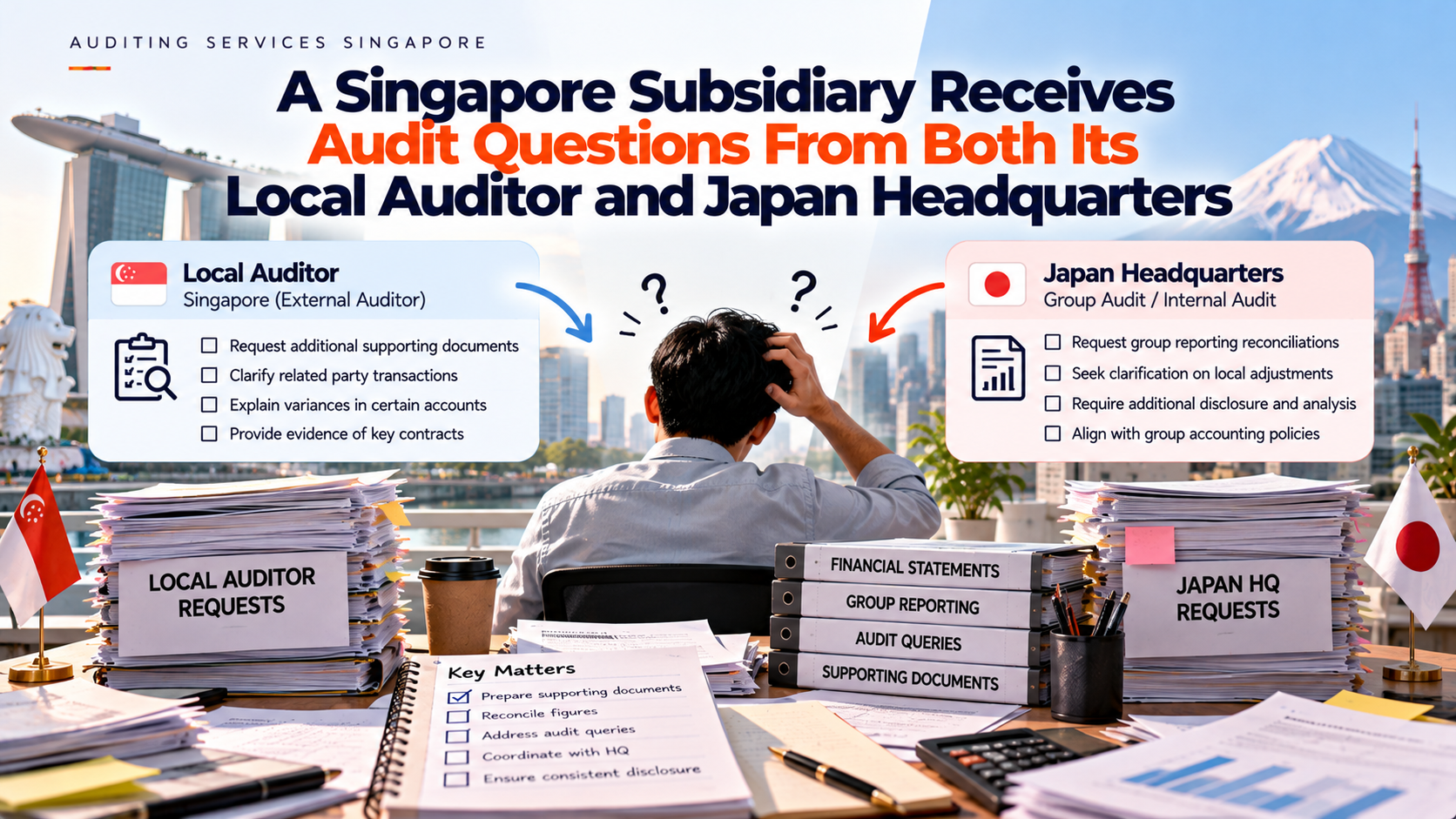
The Singapore finance team is preparing documents for its annual audit when another request arrives from Japan headquarters. The parent company needs explanations for several balances, a revised consolidation package and confirmation of adjustments before its group reporting deadline.
Some requests look familiar. The local auditor has already asked about the same receivables, inventory and intercompany transactions. Other questions use different account names or refer to figures from an earlier submission. The team spends more time comparing requests than resolving them.
Kazuma PAC provides audit, accounting and parent company reporting support for businesses in Singapore, including Japanese companies. For a subsidiary managing parallel requests, the practical challenge is to provide consistent information while recognising that local audit work and headquarters reporting may serve different purposes. Clear responsibilities, reconciled figures and controlled versions help the team respond with confidence.
Establish Who Is Asking and Why
A request from Japan headquarters is not necessarily an instruction from the group auditor. It may come from the parent’s consolidation team, financial controller, internal audit function or another reviewer.
Identify the requester and the purpose before preparing the response. A question about an overdue receivable might concern collectability, a group reporting adjustment or an explanation of working capital performance. Similar wording can conceal different information needs.
The local financial statement audit has its own scope and reporting responsibilities. Where the local auditor also performs work for a group audit, that work should be understood through the relevant engagement arrangements and instructions.
Clarifying these distinctions prevents the subsidiary from treating every headquarters question as an additional audit procedure. It also helps route technical audit matters to the appropriate professionals rather than leaving the finance team to interpret instructions between them.
Confirm the Reporting Frameworks and Deliverables
The Singapore statutory financial statements and the parent company’s consolidation package may not use identical formats or accounting policies. Headquarters may request adjustments to align local information with group requirements.
The team should identify the applicable local framework, the group reporting instructions and the deliverables required from each party. Do not assume that every Japanese parent uses the same accounting framework or reporting template.
Prepare a short list of required outputs, such as local financial statements, a group reporting package, supporting schedules and any separately agreed auditor communications. Confirm whether each item is preliminary, reviewed or final.
This helps management understand what has actually been completed. Finishing a local reporting schedule does not necessarily mean the corresponding group submission is ready, particularly if it requires additional mapping or adjustments.
Build One Calendar With Separate Deadlines
The parent may need information before the Singapore audit is complete. That timing difference should be planned for rather than treated as an unexpected problem each year.
Create a calendar covering the local close, headquarters submissions, audit fieldwork, review meetings and final approvals. Identify dependencies, including information that must come from sales, operations or another group entity.
Where headquarters needs early figures, agree how provisional information will be labelled and how later changes will be communicated. The team should not describe an unfinished package as audited simply because it contains figures already discussed with the local auditor.
Allow time for questions and corrections. A deadline that covers only the initial upload leaves no room for the review that follows and encourages last-minute changes without proper explanation.
Use a Shared Request Register
Requests arriving through separate emails can easily overlap or become lost. A shared register gives the finance team a central view of what is required, who owns the response and what remains outstanding.
Each item should identify the requester, reporting period, subject, due date and supporting document reference. Record whether the response is being prepared, awaiting review or has been submitted.
Where two requests concern the same schedule, link them rather than maintaining separate calculations unnecessarily. However, confirm that the underlying requirements are genuinely the same before reusing a response.
The register should also distinguish a document supplied from an issue resolved. Sending a spreadsheet does not mean the reviewer has accepted the explanation or completed the related work.
Reconcile the Local Trial Balance to the Group Package
A clear reconciliation between local figures and headquarters reporting can answer many questions before they arise. It should explain account mapping, group policy adjustments and other changes made during package preparation.
For illustration, suppose the local accounts show a S$200,000 provision. The group package includes a further S$30,000 adjustment under the group’s reporting requirements. Headquarters sees S$230,000, while the local auditor asks about the S$200,000 in the statutory records.
The difference may be explainable, but the team needs a documented basis for both amounts. A reconciliation should identify the adjustment, its purpose, approval and whether it belongs only in the group package.
Without that explanation, reviewers may conclude that they are looking at inconsistent records. With it, the discussion can focus on whether the adjustment is appropriate rather than on locating the source of the difference.
Control Versions Before Circulating Figures
A common source of confusion is the circulation of several files labelled “final.” Headquarters may be reviewing the first submission while the local auditor works from a revised trial balance.
Assign clear version identifiers and maintain a record of changes. Each package should show its reporting date, preparation date and status. Supporting schedules should connect to that version.
When figures change, provide a concise explanation of the affected accounts and the reason. Recipients should not have to compare entire workbooks to discover that an accrual or revenue adjustment has been added.
Avoid silently replacing a file after submission. A controlled update gives reviewers a clear basis for continuing their work and helps the subsidiary demonstrate which information supported each conclusion.
Resolve Differences in Terminology
Account descriptions and reporting terms may differ between the Singapore team and headquarters in Japan. A translated label can also imply a broader or narrower category than intended.
Maintain a consistent mapping between local account codes and group reporting lines. Where a term is ambiguous, explain what is included and provide the relevant breakdown.
For example, a headquarters request for “other receivables” might include balances that Singapore reports separately as deposits or amounts due from related companies. The team should clarify the scope before concluding that a schedule is missing.
Where Japanese and English explanations are used, keep the underlying amounts and references consistent. Translation should preserve the accounting meaning, particularly for estimates, disputed items and provisional conclusions.
Prepare Explanations That Stand on Their Own
A response that makes sense to the local team may be difficult for a reviewer in Japan to understand without background. Avoid short explanations that depend on knowledge of the customer, supplier or transaction.
A useful response identifies the amount, the underlying event, the accounting treatment and the evidence supporting it. Where uncertainty remains, state what is unresolved and the next action.
For an overdue customer balance, that might mean explaining the invoices involved, the collection history, current correspondence and management’s assessment. Simply writing “customer will pay” gives the reviewer little to evaluate.
Kazuma’s parent company reporting support and consolidation package preparation services are relevant to organising this information. A clear explanation can reduce repeated clarification, while management remains responsible for the facts and judgments supplied.
Coordinate Audit Communications Through the Appropriate Channels
Where a group audit involves component auditors, communication between the auditors forms part of the audit process. The subsidiary should help arrange access and provide information, but it should not assume responsibility for determining the auditors’ respective procedures.
Clarify the relevant contacts early. Technical questions about group audit instructions, reporting thresholds or the work requested should reach the appropriate audit teams directly.
The subsidiary can maintain visibility over information requests and deadlines without becoming the only intermediary for every professional discussion. This reduces the risk that instructions are paraphrased incompletely.
Document the agreed communication arrangements. Efficient coordination should support the auditors’ independence and responsibilities, rather than imply that headquarters or local management can decide what evidence is sufficient for an audit conclusion.
Do Not Assume One Audit Resolves Every Reporting Question
Headquarters may reasonably ask questions after the local audit work has progressed. Its reporting package could include different disclosures, policy adjustments or information relevant to the wider group.
Conversely, a balance accepted for an internal headquarters report does not automatically resolve the local auditor’s questions. The purpose, scope and evidence requirements may differ.
The team should establish whether an apparent repeat request seeks new information or simply results from a version mismatch. Where the evidence already exists, provide the correct reference and explain how it addresses the question.
This approach avoids unnecessary duplication without dismissing legitimate requests. The aim is consistent underlying information, not an assumption that every reviewer must reach completion at the same time.
Track Adjustments Through Both Reporting Processes
An adjustment identified during the local close may need to flow into the headquarters package. A group reporting adjustment may have no corresponding local ledger entry. The team needs to distinguish the two.
Maintain an adjustment log showing the amount, reason, approval and reporting destination. Record whether the entry has been posted locally, included only in the group package or remains under assessment.
After a significant change, check the affected schedules and disclosures. Updating the trial balance alone may leave supporting documents inconsistent.
This is especially important when headquarters has already submitted information to its own reviewers. The parent needs a clear notification of changes that affect its package, rather than discovering them when comparing later documents.
Protect Sensitive Information While Supporting Access
Payroll, customer contracts and commercially sensitive correspondence may be requested during the reporting process. The team should use approved channels and confirm who needs access.
A shared folder can help, provided permissions, document versions and retention arrangements are managed appropriately. Sending unrestricted links or repeatedly forwarding full files can create unnecessary exposure.
Access to auditor working papers is a separate matter from access to company records. The subsidiary should not promise to distribute an auditor’s files without the relevant arrangements and permissions.
A clear information-sharing process supports timely responses while preserving confidentiality. It also helps the team retain a record of what was provided, to whom and for which purpose.
Escalate Decisions That the Finance Team Cannot Make Alone
Some questions require management decisions rather than another spreadsheet. A disputed estimate, proposed settlement or change in reporting policy may need input from local directors and headquarters.
Identify these items early and present the decision needed, the supporting facts and the reporting deadline. Leaving them in the general request list can make a significant issue look like routine administration.
Where local and headquarters views differ, document the issue and obtain the appropriate technical advice. The finance team should not select a treatment merely to satisfy the most urgent email.
A short meeting focused on unresolved decisions can be more effective than prolonged correspondence. Record the conclusion, responsible person and effect on each reporting deliverable.
Build a Repeatable Reporting Process
After the reporting cycle, review which questions were repeated and why. Some may reveal recurring weaknesses in schedules, terminology or the handover between Singapore and Japan.
Update the reporting instructions and supporting templates accordingly. A recurring request for the same breakdown is a reason to include it in the standard package, provided it remains relevant.
Kazuma PAC provides audit, accounting and parent company reporting services for businesses operating in Singapore, including Japanese companies. These services are relevant to subsidiaries seeking clearer financial records and a more organised reporting process.
The practical starting point is a shared calendar, a reconciled reporting package and a request register with named owners. Together, they help the Singapore team respond consistently, keep headquarters informed and distinguish genuine accounting questions from avoidable confusion over documents and versions.