
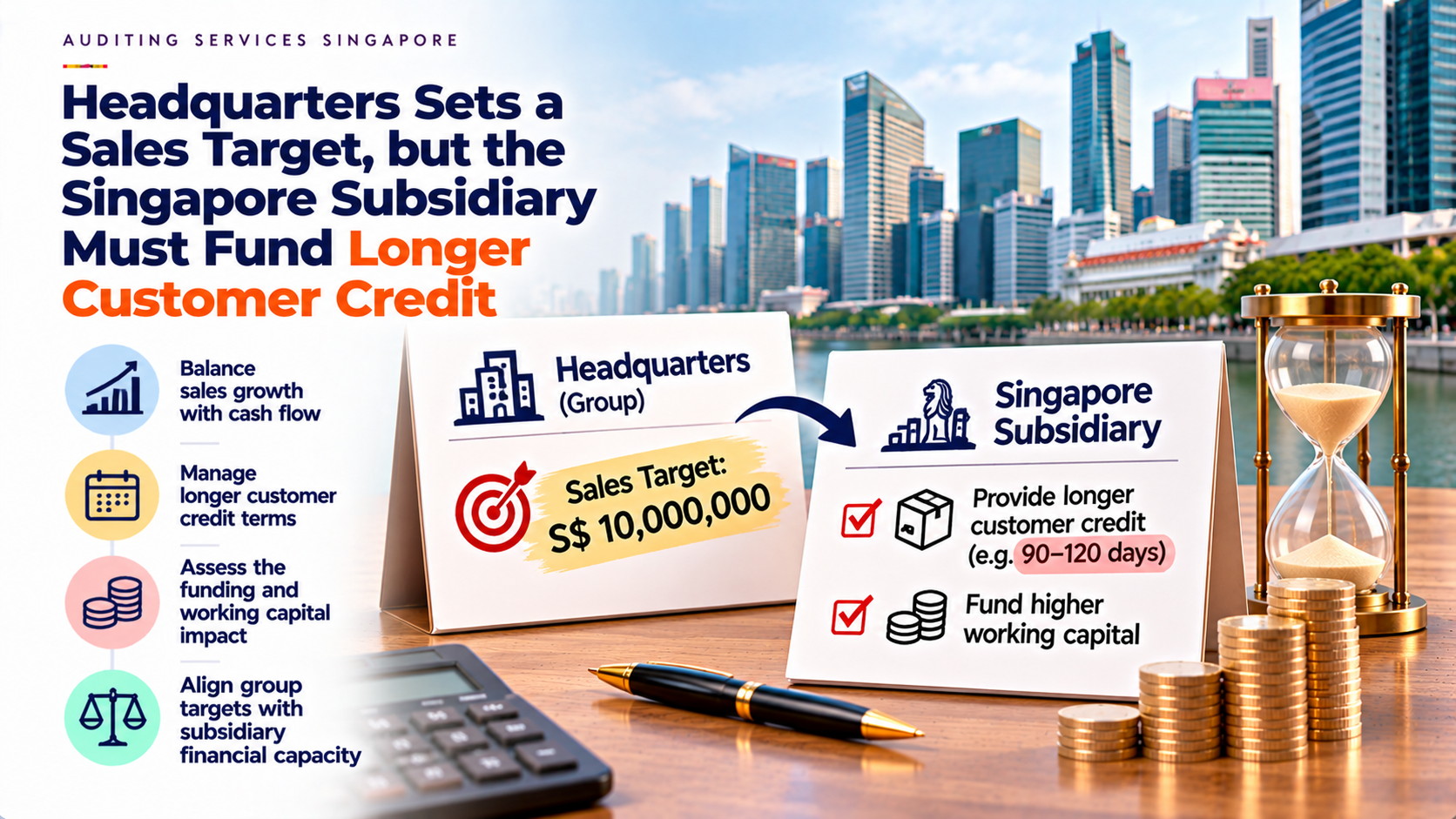
Japan headquarters sets an ambitious sales target for its Singapore subsidiary. The local team identifies customers who could support that growth, but securing their orders requires longer payment terms. Revenue may increase during the quarter, while the cash arrives several months later.
The subsidiary still needs to purchase stock, pay employees and settle suppliers during that interval. A target that appears achievable from a sales perspective can therefore create a funding requirement that was absent from the original budget. Local management must explain how the proposed growth will be financed before committing to customer terms.
Kazuma Public Accounting Corporation supports Japanese companies in Singapore with accounting and parent-company reporting. Consistent financial information helps headquarters understand the relationship between sales targets, customer credit and local cash requirements. The discussion becomes more useful when finance translates the commercial plan into amounts, dates and funding decisions.
Establish What Changed in the Sales Plan
The original budget may have assumed that customers would pay within 30 days. The revised plan may depend on offering 60 or 90 days to larger accounts. Even if the sales target remains unchanged, the cash assumptions supporting it have changed materially.
Identify which customers require extended terms, the expected sales volumes and when those arrangements would begin. Distinguish requests still under negotiation from terms already approved. Finance needs that detail to assess the funding effect.
Also check whether the payment clock starts at invoice date, delivery, customer acceptance or another event. An agreement described as “60 days” may result in a longer wait if invoices cannot be submitted until a separate approval is completed. The forecast should reflect the actual collection process.
Translate Credit Terms Into Receivables
A sales target describes activity over a period. The receivables balance represents money that remains uncollected at a particular date. Extending payment terms increases the amount likely to remain outstanding, even when customers pay exactly as agreed.
Consider a hypothetical subsidiary making S$300,000 of monthly credit sales. Using a simplified 30-day month and steady sales, 30-day collections would support an approximate receivables balance of S$300,000. Moving to 60 days would increase that amount to approximately S$600,000.
If monthly sales also rise to S$400,000, receivables at 60 days would be approximately S$800,000. Compared with the original position, an additional S$500,000 would be tied up in customer balances. These simplified figures exclude GST, seasonality and late payments, but demonstrate why volume and payment terms need to be assessed together.
Distinguish Receivables Growth From the Total Funding Need
The additional S$500,000 in the example is not automatically the final borrowing requirement. The subsidiary’s available cash, supplier terms, inventory levels and other cash movements also affect the amount it needs to fund.
Some purchases may be paid after the related customer receipt, while others require deposits before production begins. Additional staff or storage may create payments before the first sale. Existing cash reserves may absorb part of the requirement, but using them reduces the buffer available for other commitments.
Prepare a forecast that combines these movements rather than treating a receivables calculation as a complete funding proposal. Management should understand both the increase in customer credit and the lowest expected cash balance after all relevant receipts and payments.
Check When Suppliers Expect Payment
Longer customer terms become more difficult to support when suppliers require prompt settlement. A subsidiary that pays suppliers within 30 days but collects from customers after 90 days must finance the interval, including any time goods spend in stock.
Review supplier terms by major product or purchasing arrangement. Identify advance payments, deposits and credit limits that could change as order volumes increase. Do not assume that historical payment delays represent agreed supplier financing.
If procurement expects to negotiate longer terms, show that as a separate assumption until confirmed. The funding plan should distinguish arrangements already available from improvements management hopes to obtain. This prevents the sales target from depending on several unapproved concessions at once.
Include Inventory Purchased Before the Sale
A larger order pipeline may require stock to be purchased earlier or held in greater quantities. That creates a cash commitment before the customer invoice enters the receivables ledger.
Map the sequence from purchase commitment to supplier payment, delivery, invoicing and collection. Where imports or production lead times are significant, include them explicitly. A customer’s 60-day credit period may be only the final part of a much longer cash cycle.
Review whether the sales plan requires additional safety stock or minimum purchase quantities. The subsidiary could otherwise fund both slower collections and unsold inventory. Finance should test the combined requirement before management approves purchasing based on the higher target.
Assess the Customer’s Ability to Pay
Longer credit terms increase exposure to the customer. An attractive order value does not establish that the balance will be collected as forecast. Commercial demand and creditworthiness need separate consideration.
Review payment history, disputes, overdue balances and available information about the customer’s financial position. For a new account, establish what evidence supports the proposed credit limit and payment assumptions. A larger order may require a different approval from routine trading.
Keep customer concentration visible. If much of the growth depends on one buyer, a delayed receipt can affect the subsidiary’s entire payment plan. The funding proposal should show that dependence so headquarters can assess the risk alongside the expected revenue.
Measure the Margin After Funding and Service Costs
The additional sales may carry an acceptable gross margin while generating a lower contribution after financing and service costs. Longer credit can create interest expense, collection work and greater exposure to non-payment.
Estimate the additional costs using the proposed volumes and realistic collection timing. Include other concessions attached to the order, such as delivery requirements, rebates or returns arrangements. Avoid reviewing each concession independently when the customer receives them as one commercial package.
The result should help management assess the full offer. It may support a different price, staged payments or a smaller initial credit limit. The purpose is to understand what the business earns for the resources committed, rather than treating every increase in revenue as equally valuable.
Build a Forecast Around the Transition
The first months after extending terms may be particularly demanding. Existing invoices continue to be collected, but receipts from new sales arrive later. At the same time, purchasing and operating payments may rise immediately.
Use a weekly cash forecast during the transition and a longer outlook covering the expected trading cycle. Link major receipts to customers and explain the collection assumptions. Include existing commitments that are unrelated to the expansion but still require payment.
Identify the peak funding requirement and its date. An annual cash total can conceal a shortage early in the plan. Headquarters needs to see when funds are required, how long they remain committed and what would allow the subsidiary to reduce the balance.
Present the Funding Request Alongside the Sales Target
Local finance should avoid presenting the cash requirement as a separate surprise after the sales budget is approved. The target and the credit terms supporting it belong in the same decision.
Prepare a concise proposal showing expected sales, margin, customer terms, inventory needs and peak funding. Explain the difference from the original budget and identify which assumptions have been confirmed. Where several options exist, show their commercial and cash consequences consistently.
Kazuma’s parent-company reporting and periodic financial reporting services are relevant to preparing this information for Japanese headquarters. A common set of figures helps local management and the parent discuss the same plan, including the resources needed to deliver it.
Clarify Who Will Provide the Funds
A statement that headquarters will support growth should be translated into a specific arrangement. The subsidiary needs to know the amount available, when it can be drawn and what approvals or conditions remain.
If group funding is proposed, establish the form and terms with the appropriate advisers where necessary. If bank financing is expected, confirm its availability and restrictions before treating it as committed. An unapproved facility application should remain distinguishable from usable funds.
Also consider the currency of the funding and customer receipts. Borrowing in one currency while collecting in another can create additional exposure. The forecast should make those flows visible without assuming that all group cash can be transferred freely whenever the subsidiary needs it.
Consider Changes to the Commercial Structure
The customer’s request may allow room for negotiation. A deposit, staged billing or phased deliveries could reduce the period during which the subsidiary funds the entire order. Different terms may be appropriate for different customers.
Assess these possibilities against the customer’s operational needs and the company’s ability to administer them. A staged-payment arrangement is useful only if the milestones are clear and the collection process works in practice. Frequent disputes over acceptance can undermine the expected cash benefit.
Where management offers an early-payment discount, compare its cost with the expected funding benefit and likelihood of uptake. The decision should be based on the full economics rather than assuming that faster collection is worthwhile at any price.
Test What Happens When Customers Pay Late
The agreed credit period is the starting point for a forecast, not proof that every payment will arrive on time. Test the effect of realistic delays, particularly for large or newly acquired customers.
Show what happens if a major receipt moves by two or four weeks while supplier payments remain unchanged. Include a scenario in which sales grow more slowly but inventory has already been purchased. That combination can create more pressure than simply achieving lower revenue.
Identify responses that management can execute. These may include limiting further credit, slowing discretionary purchases or drawing on confirmed contingency funding. The plan should state when action is triggered, rather than relying on headquarters to resolve an urgent shortage at the last moment.
Monitor Credit Exposure as Orders Increase
Once the plan begins, compare actual customer balances and receipts with the approved assumptions. Review overdue amounts, credit-limit utilisation and orders awaiting delivery. A customer may remain within its payment terms while approaching a concentration level that requires additional approval.
Sales and finance should share the same information. Otherwise, the commercial team may continue accepting orders while finance is negotiating overdue payments or trying to preserve cash for suppliers. Clear escalation points help both teams understand when further commitments need review.
Track forecast accuracy as well as revenue performance. Repeatedly moving expected receipts into the next period indicates that assumptions or collection processes need adjustment. Management should not continue using the original cash plan simply because sales are close to target.
Keep Reporting Incentives Consistent With the Funding Plan
A subsidiary measured only on revenue may feel pressure to accept terms that increase the parent’s sales figures while weakening local liquidity. Management reporting should therefore show collection performance and working capital alongside growth.
This does not require replacing commercial targets with a single cash measure. A balanced review can show revenue, margin, overdue balances, inventory and funding use together. Explain why movements occurred so that deliberate investment in growth is distinguishable from avoidable collection problems.
Headquarters should also understand the timing of the expected benefit. A funding increase during a planned expansion may be reasonable, but the subsidiary needs a supported path towards the intended cash position. Accountability is clearer when that path is agreed before the commitments are made.
Fund the Conditions Needed to Achieve the Target
A sales target becomes a workable business plan when its purchasing, credit and funding assumptions are connected. Longer customer terms can support growth, but they also commit resources that the Singapore subsidiary must obtain and manage.
Finance should make the additional exposure visible through customer-level assumptions, dated cash forecasts and confirmed funding arrangements. Regular review then allows management to respond when collections, orders or supplier requirements differ from the plan.
For Japanese-owned businesses in Singapore, Kazuma PAC can discuss the accounting and parent-company reporting needed to support these conversations. Bring the sales budget, customer terms and cash forecast so that the financial information presented to headquarters reflects the full commitment behind the target.