
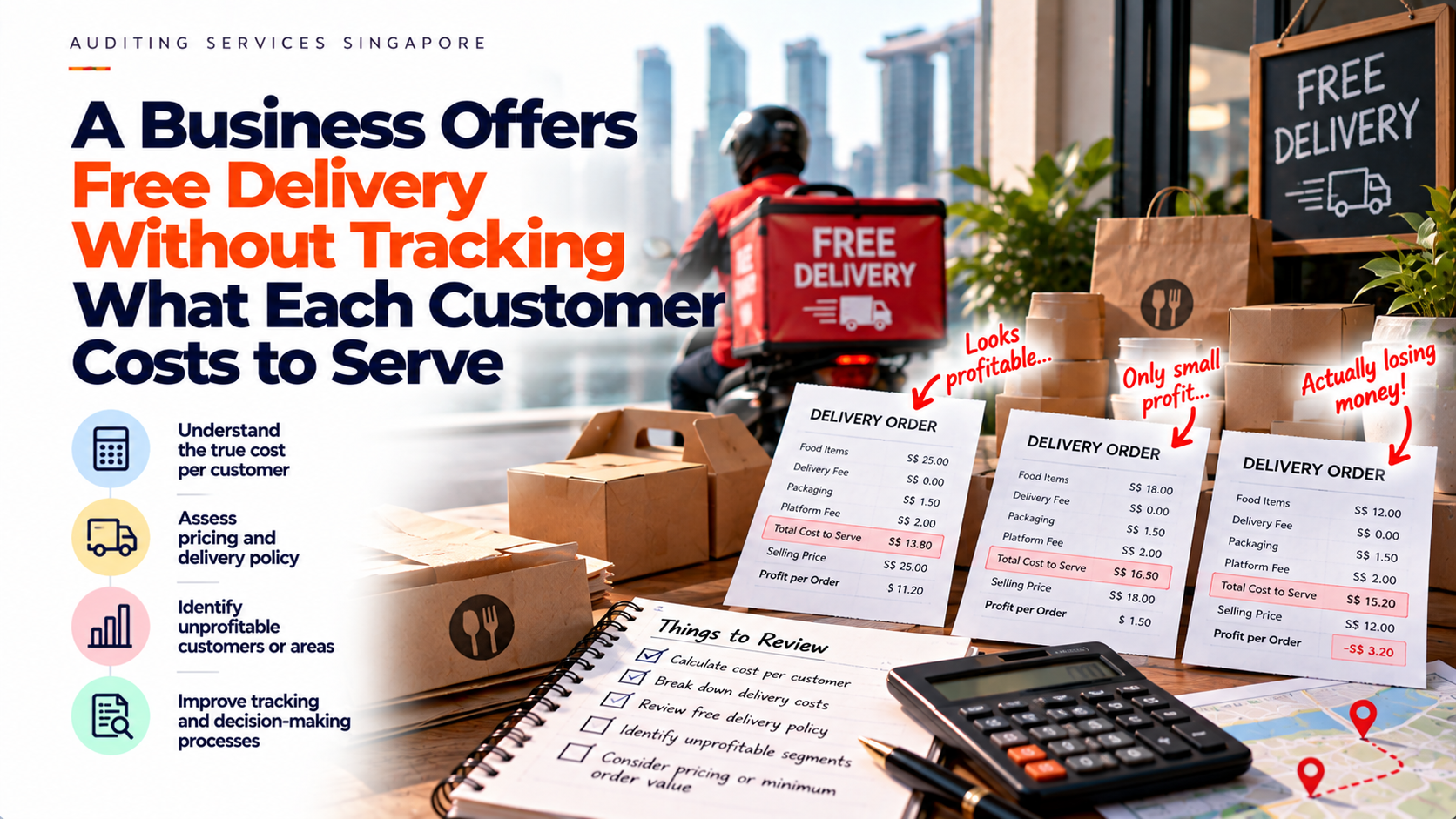
Free delivery helps remove friction from a sale. Customers can place an order without calculating transport charges, while the sales team has one less objection to address. For a distributor competing on service, it can become an established part of the customer relationship.
The financial effect is less obvious when delivery costs sit in a general expense account. Sales reports show which customers buy the most, but they may not show which customers require frequent trips, urgent dispatches or repeated delivery attempts. An account can appear attractive before those demands are considered.
Kazuma PAC provides accounting, periodic financial reporting and parent company reporting support, including services for Japanese companies operating in Singapore. For a local subsidiary offering free delivery, clearer cost information can help management explain the account’s contribution both locally and to headquarters in Japan. The starting point is understanding what it takes to fulfil the orders behind the revenue.
Free Delivery Still Uses Business Resources
A customer does not pay a separate delivery charge, but the business still uses drivers, vehicles, fuel, handling time or courier services. These resources must be funded through the overall economics of the sale.
The cost varies with the delivery arrangement. A large scheduled order may fit efficiently into an existing route. Several small orders from the same customer can require more picking, packing and stops even when their combined sales value is identical.
Special requirements can add further work. Restricted receiving hours, advance booking procedures and requests to deliver to several departments can affect the time needed to complete an order.
Management should therefore look beyond whether delivery expenditure is within the overall budget. The more useful question is how different customer arrangements consume the resources that the business is paying for.
Define the Service Included in the Selling Price
“Free delivery” can become an open-ended promise if its scope is unclear. Customers may assume it includes urgent orders, split shipments, returns collection and repeated visits when nobody is available to receive the goods.
Review the published terms and the arrangements agreed by the sales team. Identify which services are included and which require separate approval.
The business may deliberately provide a higher level of service to a strategic account. That decision can be reasonable, but management should understand the commitment and its expected cost.
A defined service standard gives operations something concrete to plan around. It also allows finance to distinguish the cost of fulfilling the agreed offer from additional requests accepted informally after the sale.
Compare Customers With Similar Sales
Consider a hypothetical Japanese-owned distributor operating in Singapore. Two customers each purchase S$20,000 of goods in a month and generate S$4,000 of product gross profit before outbound delivery and order-handling costs.
Customer A places four consolidated orders. Customer B places twenty smaller orders and frequently requests separate dispatches. Assume a supported management analysis estimates fulfilment costs of S$320 for Customer A and S$1,400 for Customer B.
On that simplified basis, the amounts remaining after those costs are S$3,680 and S$2,600 respectively, before other business expenses. The customers generate the same sales and product gross profit, but different contributions after fulfilment.
These figures are illustrative, not industry benchmarks. They show why revenue alone can conceal important differences. They also do not mean that losing Customer B would automatically save S$1,400, since some allocated costs may continue regardless of that account.
Build the Analysis From Order and Delivery Records
The accounting ledger provides total expenditure, but operational records explain how that expenditure relates to customers. Connect sales orders with dispatch records, courier invoices and delivery outcomes.
Useful information includes the number of completed deliveries, order size, route, special handling and whether a second attempt was required. Start with fields the business can maintain reliably rather than designing a complex exercise that staff cannot sustain.
A customer reference on courier invoices can make direct costs easier to trace. For an internal fleet, route and stop records may provide a practical basis for understanding activity.
Check the quality of the records before drawing conclusions. Duplicate dispatch entries, cancelled orders and missing customer codes can distort the analysis. An apparently expensive account may partly reflect data errors that need correction.
Distinguish Direct Costs From Shared Capacity
Some costs can be linked directly to a delivery, such as an external courier charge for an urgent shipment. Others, including vehicle lease payments and a driver’s regular salary, support several customers.
A customer profitability report may allocate shared costs to show how resources are used. A decision about accepting one additional order requires a different question: what costs and capacity demands will actually change?
For example, adding a nearby stop to a vehicle with spare capacity may involve limited additional expenditure. The same request could be much more expensive if it requires overtime or another vehicle.
Use both perspectives clearly. Allocated costs help assess whether the overall service model supports the business. Incremental costs and capacity constraints help assess a particular decision. Treating the two as interchangeable can lead management to reject useful orders or underestimate the long-term cost of growth.
Include the Work Before and After the Trip
Delivery costs do not begin when the vehicle leaves the warehouse. Each order may require picking, packing, documentation and coordination with the customer.
Small orders can repeat those tasks more frequently. Returns, delivery discrepancies and failed attempts create further work after the initial dispatch.
The review should identify the activities relevant to the business without turning every minor task into a separate calculation. A practical grouping might distinguish standard orders, urgent dispatches and exceptional handling.
This can reveal a more useful explanation than transport expenditure alone. The account’s main cost may arise from repeated order processing rather than distance, making order consolidation a better response than changing the delivery route.
Check Whether the Company Causes the Extra Trips
Frequent deliveries are not always driven by the customer. Stock shortages, picking mistakes and incomplete dispatches may force the distributor to split an order or return to the premises.
Separate customer-requested services from trips caused by internal problems. Otherwise, the profitability report may penalise an account for the supplier’s own operational weaknesses.
For example, a customer ordering once a week may receive three deliveries because stock is unavailable at the original dispatch date. Charging that customer a small-order fee would not address the cause.
The analysis should identify who or what triggered the extra work. That gives management a basis for improving inventory availability, dispatch accuracy or communication before changing customer terms.
Explain the Local Position to Japan Headquarters
A Singapore subsidiary may report sales and product margins using a group template that shows delivery expenses only at company level. Headquarters can see the total cost but may not see which service commitments explain it.
Prepare a supplementary analysis that connects customer revenue with the relevant fulfilment activity. Reconcile it to the local accounts and explain the allocation methods used.
Keep the definitions consistent. If delivery costs already form part of the reported cost of sales, subtracting them again in a customer analysis would understate contribution. The report should clearly identify which costs are included at each stage.
Kazuma’s periodic financial reporting and parent company reporting support are relevant to organising these explanations. A clear reconciliation helps headquarters assess local performance without mistaking a reporting difference for a change in the business itself.
Review Delivery Promises Alongside Other Concessions
Free delivery may sit alongside volume rebates, extended payment terms or discounted product prices. Looking at each concession separately can obscure the total cost of supporting the customer.
Bring the agreed terms together when reviewing an important account. Identify the product margin, delivery arrangement, servicing requirements and collection pattern.
A customer with modest delivery demands may still tie up significant cash through slow payment. Another may pay promptly but require frequent urgent dispatches. The commercially appropriate response can differ.
This broader view also helps the sales team prepare for renewal discussions. Management can decide which benefits it is willing to provide and what commitment it expects in return, rather than adding concessions one request at a time.
Test Alternatives Before Removing Free Delivery
The business may improve the arrangement without withdrawing free delivery entirely. Scheduled delivery days, order cut-off times or agreed consolidation can reduce repeated work.
A minimum order requirement is another option to assess, but its level should reflect the company’s circumstances. A threshold that is too high could discourage profitable orders, while one that is too low may have little effect.
Discuss the proposed change with the customer and review existing contractual commitments before implementation. Customers may be able to combine orders if the supplier provides a dependable schedule.
Where urgent delivery remains available, define how it is approved and priced. The purpose is to make the service commercially sustainable while preserving the elements customers value.
Separate Strategic Exceptions From Uncontrolled Exceptions
Some accounts justify additional service because of their wider role in the business. A customer may provide predictable demand, introduce the supplier to new buyers or support a developing product range.
Those benefits should be described and reviewed rather than used as a permanent explanation for any level of cost. Identify the reason for the exception, the person approving it and the point at which it will be reconsidered.
A temporary arrangement for a new account should not become an indefinite commitment simply because nobody updates the customer terms. Likewise, a strategic relationship should not depend on individual employees making undocumented promises.
Recording exceptions allows management to distinguish deliberate commercial investment from a service pattern that has grown without review.
Use a Trial Period to Check the Result
Before applying a major policy change across the customer base, test a suitable approach with a defined group of accounts. Establish the starting position and the measures that will indicate whether the change is working.
Review delivery frequency, fulfilment expenditure, sales contribution and customer response. A fall in delivery costs is not necessarily a success if the business loses a larger amount of profitable sales.
Consider the operational effect as well. Consolidated orders may make warehouse planning easier, while overly restrictive schedules could create dispatch peaks that require additional resources.
Explain unusual events during the trial so that management does not draw conclusions from an unrepresentative month. The objective is a repeatable improvement, supported by evidence rather than a favourable short-term result.
Keep the Analysis Connected With the Monthly Accounts
Customer-level analysis is most useful when it remains connected to the accounting records. Reconcile the costs included, identify exclusions and explain material changes in the method.
Review the significant exceptions regularly. An account that was inexpensive to serve last year may now place smaller orders or require delivery to additional locations.
The process should also inform budgets and quotations. If a proposed customer arrangement requires dedicated delivery capacity, that requirement belongs in the financial assessment before the service promise is made.
Assign responsibility for keeping the operational data current. Finance can prepare a report, but sales and logistics need to communicate changes that affect the calculation.
Make Free Delivery an Informed Commercial Choice
Free delivery can remain a valuable part of a distributor’s offer. The challenge is understanding whether the sales it supports provide enough contribution for the service being delivered.
A useful review connects order patterns, delivery activity and accounting costs. It distinguishes direct expenditure from shared capacity and recognises when internal problems create unnecessary trips.
Kazuma PAC provides accounting and financial reporting support for businesses in Singapore, including Japanese companies reporting to their parent organisations. Businesses reviewing customer profitability can discuss how their financial records and management reports support that assessment.
A practical starting point is a comparison of several customers with similar sales but different delivery patterns. Trace the work required to serve them, explain the cost assumptions and assess possible changes. Management can then decide where free delivery strengthens the relationship and where the arrangement needs clearer limits.