
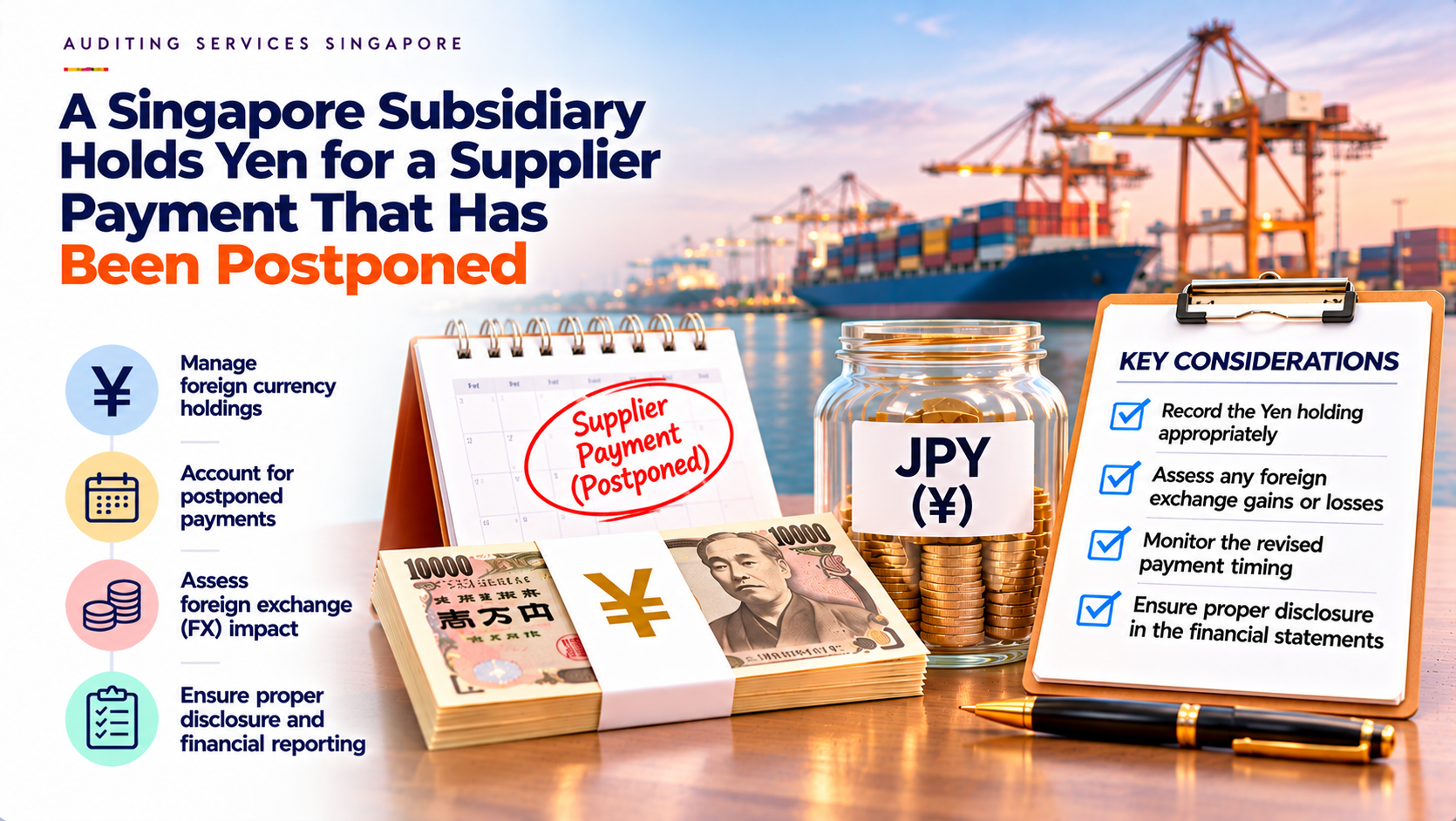
The Singapore subsidiary bought Japanese yen to settle a supplier invoice. The payment was expected within the month, and management wanted to ensure the currency was available. Before the transfer took place, the supplier agreed to postpone payment following a change in the delivery schedule.
The yen remains in the bank account. Meanwhile, the subsidiary needs Singapore dollars for payroll, rent and local suppliers. Headquarters asks whether the balance should be retained, used elsewhere or converted back. Each option affects liquidity and the company’s future currency exposure.
Kazuma Public Accounting Corporation supports Japanese companies in Singapore with accounting and parent-company reporting. In this situation, reliable financial information helps management understand what has changed since the yen was purchased. The decision should begin with the payment obligation, its revised timing and the subsidiary’s other cash commitments.
Confirm What Has Actually Been Postponed
A delayed delivery does not automatically mean that the payment date has changed. The supplier may still expect an advance, a contractual instalment or payment against an invoice already issued. Finance should establish the agreed position before treating the yen as available for another purpose.
Obtain written confirmation of the revised payment terms. Identify whether the amount remains unchanged, whether payment will occur in stages and whether the postponement depends on another event. If discussions remain ongoing, record the uncertainty rather than inserting an assumed date into the forecast.
The accounting position also needs to reflect the underlying transaction. An existing payable is different from a planned purchase for which no liability has yet been recognised. The company should understand which situation applies before evaluating its currency balance.
Establish Why the Yen Was Purchased
The original decision provides useful context. The subsidiary may have bought yen for one specific invoice, several expected purchases or a general reserve approved by headquarters. Those purposes can lead to different conclusions when one payment moves.
Retain the original approval and identify the assumptions behind it. Was the amount based on a confirmed obligation? Did management intend to hold the currency until settlement, or was it part of a wider treasury arrangement?
If the purchase was tied to a specific payment, the delay is a reason to review that allocation. It does not automatically justify selling the yen, but it changes the timing on which the original decision relied. Management should make the revised purpose explicit.
Separate a Yen Balance From a Forward Contract
Holding yen already purchased in a bank account is different from having a contract to buy yen at a future date. Staff may describe both arrangements as having “secured the currency”, but their cash requirements and contractual consequences differ.
Review the bank records and any foreign-exchange agreements. Confirm whether the company owns the yen, has an outstanding forward contract or has both. A postponed supplier payment does not itself amend a separate contract with the bank.
Where a forward or other derivative exists, obtain the relevant settlement, extension or cancellation terms before making changes. Those arrangements require their own assessment. The discussion below focuses primarily on yen already held in a bank account and assumes no derivative unless specifically identified.
Map the Revised Cash Requirements by Currency
A single total bank balance can conceal a shortage in the currency needed for upcoming payments. The subsidiary may hold substantial yen while lacking Singapore dollars for local commitments. Finance needs a forecast that makes both positions visible.
List expected receipts and payments separately by currency and date. Include the postponed supplier payment, other confirmed yen obligations and local operating costs. Identify any account restrictions or approval requirements affecting access to the funds.
Then assess the combined position using clearly stated conversion assumptions. This gives management a practical view of whether retaining the entire yen balance would require additional borrowing or support from headquarters. The objective is to understand the funding consequences before choosing an action.
Compare the Main Options Without Predicting the Market
Management may retain the yen for the revised supplier payment, allocate some to another confirmed yen obligation or convert part or all of it into Singapore dollars. The appropriate choice depends on payment certainty, local liquidity and the company’s approved treasury policy.
Retaining the balance preserves the currency needed for the supplier, assuming the obligation remains in yen. Converting it can release Singapore-dollar liquidity, but creates a future need to obtain yen again if the payment still proceeds.
Partial conversion may also be considered where only part of the balance is required for confirmed commitments. Each option should be evaluated using current executable terms and supported cash forecasts. A view about where the exchange rate might move should not substitute for understanding the obligations.
Illustrate the Liquidity Trade-Off
Consider a hypothetical subsidiary holding ¥20 million for a supplier payment postponed by three months. At an illustrative conversion rate of ¥100 for S$1, the balance represents S$200,000 before bank spreads and fees. The subsidiary forecasts a temporary Singapore-dollar shortfall of S$80,000.
Converting ¥8 million at that illustrative rate would provide S$80,000 before costs and leave ¥12 million. If the full supplier payment remains due, the company would later need another ¥8 million, unless it receives that amount through other business activity.
If the future rate were ¥95 for S$1, purchasing ¥8 million would cost approximately S$84,211 before charges. At ¥105 for S$1, it would cost approximately S$76,190. These are scenarios, not forecasts. They show that solving the immediate liquidity gap can create uncertainty about the cost of restoring the yen balance.
Include Borrowing Costs and Conversion Charges
Keeping the yen while borrowing Singapore dollars may be feasible, but it has a cost. Compare the expected borrowing interest and fees with the consequences of converting currency and potentially buying it again later.
Use actual bank quotations where a transaction is being considered. A published reference rate may differ from the rate available to the subsidiary, and the amount received can be affected by spreads and charges. Include any interest earned on the yen balance where relevant.
Keep the comparison consistent across options. Use the same payment dates, supplier amount and operating assumptions. Management should be able to see which costs are known and which depend on later exchange rates or changes in the payment schedule.
Check Other Yen Commitments Before Reallocating Funds
The postponed payment may not be the subsidiary’s only yen obligation. Freight, services, equipment instalments or amounts owed to group companies may also require settlement. A complete schedule prevents the same currency balance from being allocated more than once.
Identify which commitments are confirmed and which remain estimates. If the existing yen is used for another payment, update the funding plan for the original supplier. The fact that both transactions use yen does not remove the need to consider their different dates.
Similarly, expected yen receipts may reduce the need to repurchase currency, but their reliability matters. An overdue customer balance should not be treated as equivalent to cash already held. Show what happens if the expected receipt arrives after the supplier payment falls due.
Understand the Functional-Currency Reporting Effect
The subsidiary’s functional currency depends on its primary economic environment. Japanese ownership does not automatically make yen the functional currency, and Singapore incorporation does not resolve the assessment on its own.
Where yen is a foreign currency, a yen bank balance is a monetary item that generally requires translation at the reporting-date closing rate. The resulting exchange differences are usually recognised in profit or loss under the applicable requirements. Holding the yen without converting it does not necessarily prevent accounting exchange movements.
An existing yen payable may generate movements in the opposite direction, but the extent of any offset depends on amounts, timing and the accounting circumstances. A forecast purchase that has not created a recognised liability is different. Finance should explain the actual balances rather than assuming that every currency holding has an equal accounting offset.
Avoid Letting the Original Purchase Rate Drive the Decision
Management may resist conversion because the current rate is less favourable than the rate at which the yen was purchased. The historical rate explains past cash expenditure, but the current decision concerns future payments, available liquidity and alternative uses of the money.
Prepare the comparison from the position the company holds today. Explain the cash each option would release, the yen commitment remaining and the risks introduced. This helps prevent the decision becoming an attempt to wait indefinitely for a particular exchange rate.
The same discipline applies when the yen has increased in value. A favourable movement does not make the balance surplus if it is still needed for a confirmed payment. Commercial purpose and funding needs should remain central to the review.
Give Japan Headquarters a Clear Decision Paper
Headquarters may see a yen balance as readily available while local finance is concerned about Singapore-dollar payments. A concise explanation should connect both perspectives instead of reporting only the foreign-currency amount.
Show the original purpose, revised supplier terms, upcoming commitments and options considered. Include the funding gap, transaction costs and sensitivity to delayed receipts or further postponement. Identify the approval required under the group’s treasury arrangements.
Kazuma’s services include parent-company reporting and consolidation package support for Japanese clients. These services are relevant to preparing consistent financial information and explaining local reporting figures. Management remains responsible for the treasury decision and should distinguish financial reporting support from authority to trade or move funds.
Document Any Transfer to Another Group Company
Headquarters may suggest using the yen elsewhere in the group. That can be considered, but cash held by the Singapore subsidiary should not be treated as interchangeable with every other group company’s funds.
Establish the nature of the proposed transfer, its approvals and any repayment terms. Assess relevant accounting, tax and legal implications where necessary. If the subsidiary will need the money back for its supplier, the return arrangement should be supported rather than left as an informal expectation.
Include the transfer in both entities’ records and forecasts. A group-level currency match does not automatically ensure that the Singapore company will have accessible funds on the date its own payment is due.
Set a Review Date and Clear Triggers
A decision to retain the yen should include a timetable for reassessment. Otherwise, a short postponement can become an indefinite holding without anyone reviewing whether the original purpose still exists.
Useful triggers include confirmation of a new payment date, a change in the supplier amount, a significant local cash shortfall or the cancellation of the underlying purchase. Assign responsibility for monitoring these developments and updating the forecast.
Keep the supplier agreement, bank records and management approval together. This makes it easier to explain why the balance remains and what action is planned. It also reduces dependence on the employee who arranged the original currency purchase.
Keep the Currency Decision Connected to the Business
A postponed supplier payment changes when the subsidiary needs its yen, but it does not always remove the need. Management should establish the remaining obligation, assess local cash requirements and compare the consequences of retaining, reallocating or converting the balance.
A useful decision is supported by dated cash flows, realistic assumptions and clear approvals. It explains both the immediate liquidity effect and any future need to obtain yen again. That gives the Singapore team and Japan headquarters a common basis for discussing the funds.
If changing payment schedules are making currency balances difficult to explain, discuss the accounting and parent-company reporting records with Kazuma PAC. Bring the revised supplier terms, bank balances and currency forecasts so that management can review the decision using consistent, supported information.