
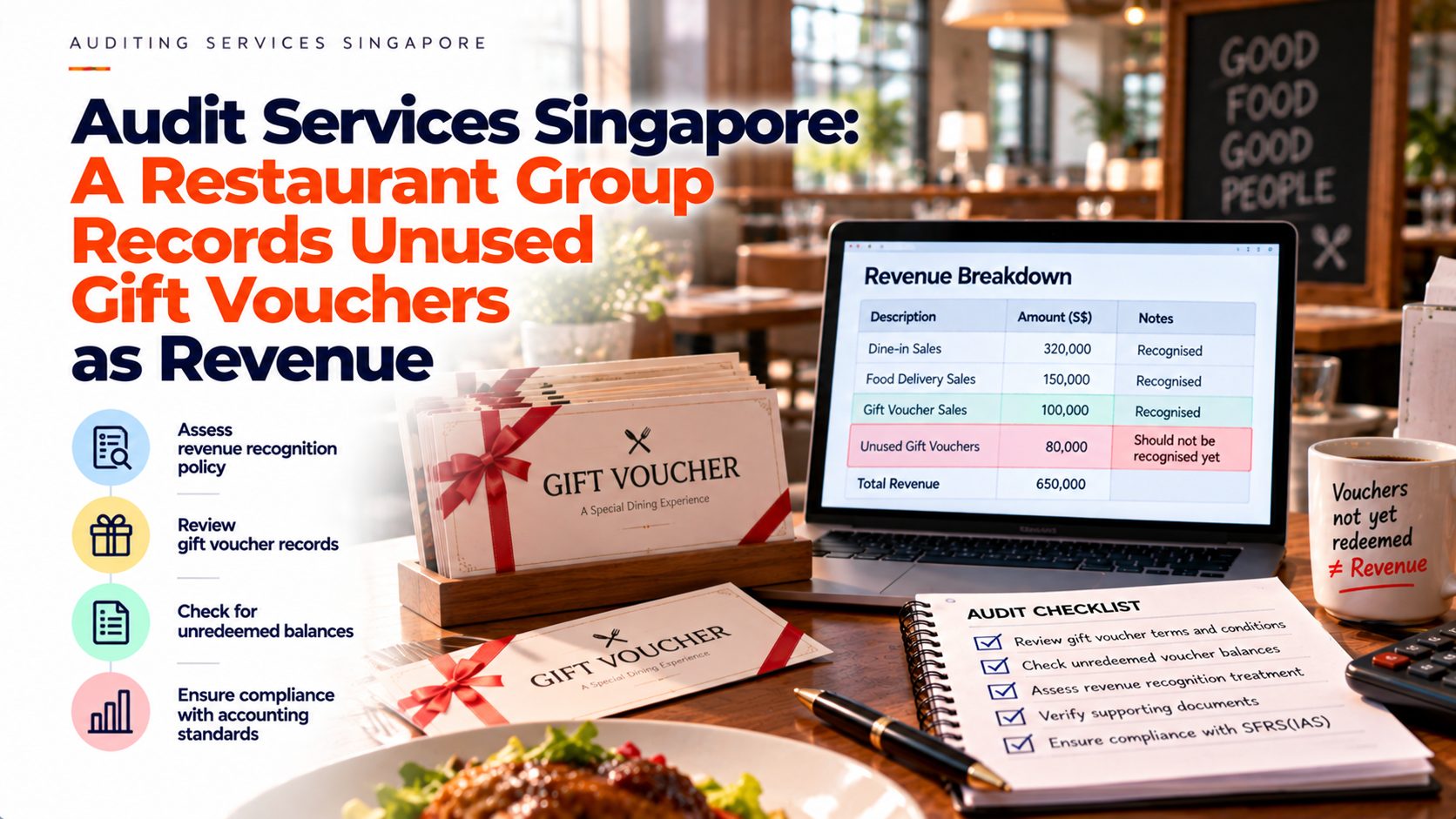
A restaurant group sells gift vouchers during a festive promotion. Customers pay immediately, cash collections increase, and management sees a successful campaign. At year-end, however, many of those vouchers remain unused while the accounts show the full proceeds as revenue.
The cash has arrived, but the restaurants may still owe customers meals and services. Recording voucher sales as revenue immediately can therefore give management an incomplete picture of performance and outstanding obligations.
For businesses considering audit services Singapore, voucher accounting deserves attention before the year-end close. Kazuma PAC provides financial statement audit and group reporting services. A clear connection between voucher sales, redemptions and remaining customer rights helps a restaurant group support the amounts reported in its financial statements.
Start With What the Customer Purchased
A paid gift voucher generally gives the customer a right to receive goods or services later. For a straightforward restaurant voucher, collecting the money does not mean the restaurant has already provided the meal.
Under the revenue recognition requirements, an advance payment for future goods or services is generally recorded as a contract liability until the relevant obligation is satisfied. A voucher being non-refundable does not, by itself, make the receipt immediate revenue.
The group should examine the actual terms of its programme. Establish where vouchers can be used, whether partial redemption is allowed and what happens to any remaining value.
These details influence both the accounting assessment and the supporting records. A voucher redeemable across several brands needs a different operational tracking process from a single-use voucher accepted only at one outlet.
Separate Paid Vouchers From Promotional Offers
Not every document described as a voucher represents the same transaction. A gift voucher purchased for cash differs from a complimentary discount code, a loyalty reward or a promotional benefit issued with another purchase.
Finance should identify the categories before preparing the year-end calculation. Combining them into one outstanding voucher total can produce a balance that does not correspond to the money collected or the obligations created.
For example, a S$100 voucher sold for S$90 should not automatically create S$100 of revenue. The relationship between the amount paid, the redemption value and any other benefits needs assessment.
Maintain separate programme records where the terms differ. This makes it easier to reconcile paid vouchers to receipts while assessing promotional arrangements on their own facts, rather than applying one accounting rule to every campaign.
Reconcile Sales, Redemptions and Outstanding Balances
A voucher reconciliation should explain the movement from the opening liability to the closing position. Relevant movements include new sales, redemptions, refunds, approved adjustments and any properly supported release for unused customer rights.
Consider a hypothetical restaurant group that sells S$120,000 of vouchers at face value. Assume GST and other complications are excluded, S$75,000 is redeemed before year-end, and no refunds or breakage revenue are recognised.
On those assumptions, the group would recognise S$75,000 from the meals provided against voucher redemption and retain a S$45,000 contract liability. Recording the entire S$120,000 as revenue would bring forward S$45,000 relating to outstanding rights.
The reconciliation should agree with both the voucher system and the general ledger. Differences require investigation, especially where the accounting entry was generated from cash collections rather than redemption activity.
Distinguish Voucher Payment From a New Cash Sale
When a customer pays for a meal using a voucher, the point-of-sale system should identify the payment method correctly. Otherwise, the group may record revenue when the voucher is sold and again when it is redeemed.
The redemption transaction needs to connect the meal provided with the reduction of the relevant voucher liability. Any additional amount paid by the customer should also be captured accurately.
For example, a customer might use a S$100 voucher toward a S$140 bill and pay the remaining S$40 by card. The records should explain both components without treating the original voucher purchase as another meal sale.
Review the system configuration and a sample of transactions. A report can appear internally consistent while carrying the same revenue twice if the sales and redemption processes were designed separately.
Unused Vouchers Do Not Automatically Become Revenue
Some customers will never redeem their vouchers. Accounting standards refer to customers’ unexercised rights as breakage, but recognising breakage requires more than observing that a balance is old.
Where the business expects to be entitled to breakage and satisfies the relevant constraint against significant revenue reversal, expected breakage is recognised in proportion to customers exercising their rights. Otherwise, recognition waits until the likelihood of exercising the remaining rights becomes remote.
The group should not release all estimated unused value at the date of sale. Nor should it adopt an arbitrary rule that every voucher outstanding for a certain number of months becomes revenue.
Management needs a documented basis for the estimate and timing. It must also consider whether any amounts are required to be remitted to another party rather than retained as revenue.
Use Reliable Redemption History
Historical data can help management understand how customers use vouchers, but the information needs to be complete and relevant. An overall percentage may conceal important differences between programmes.
Separate vouchers by meaningful characteristics, such as issue period, terms and sales channel. Corporate purchases made for employee rewards may have a different redemption pattern from vouchers bought individually as gifts.
Changes in the business can also affect the usefulness of older data. A new booking process, additional outlets or an extension of validity could encourage customers to redeem vouchers that would previously have remained unused.
Before relying on a trend, check the underlying records for missing redemptions, duplicated vouchers and system migrations. A breakage estimate based on incomplete data can convert a recordkeeping problem into an unsupported revenue adjustment.
Review Expiry Terms Alongside Actual Practice
The printed expiry date is relevant, but it should be considered with the applicable contractual and legal position and the group’s actual practices. Staff may routinely accept expired vouchers or management may have announced an extension.
If the group continues honouring vouchers, finance needs to know. Releasing the liability while outlets still accept redemption can leave the accounting treatment inconsistent with the customer experience.
Keep evidence of extensions, replacement vouchers and exceptions. Where the legal effect of expiry is uncertain, obtain appropriate advice rather than assuming the date alone ends every obligation.
The operational policy should be clear across outlets. Different practices can make it difficult to determine which rights remain outstanding and can also create inconsistent treatment of customers.
Track Obligations Across Legal Entities
A restaurant group may sell vouchers centrally while customers redeem them at outlets operated by different companies. The group needs to establish which entity owes the customer the service and how participating entities settle between themselves.
A common brand does not eliminate the need for entity-level records. The company collecting the original payment may differ from the company providing the meal.
Document the programme structure and the internal settlement process. Reconcile amounts due between entities and ensure that each reporting package reflects the arrangement consistently.
Kazuma’s services include parent company reporting support, consolidation package preparation support and group audits. For restaurant groups, a clear voucher trail across entities provides useful supporting information for both local reporting and consolidation. Management remains responsible for defining the arrangement and maintaining the records.
Investigate Manual Adjustments and Replacement Vouchers
Manual changes can weaken the connection between the customer’s rights and the system balance. Staff may replace a lost voucher, extend its validity or correct an entry after a failed redemption.
Each adjustment should have a reason, approval and link to the original record. Replacing a voucher without cancelling or appropriately linking the original can leave two active references for one purchase.
The reverse problem can also occur. A voucher may be marked redeemed even though the transaction was cancelled, leaving the customer with a valid claim that the system no longer shows.
Review unusual adjustments and repeated overrides as part of the close process. The objective is to establish a reliable population of outstanding vouchers before calculating the related liability or assessing breakage.
Keep Platform Settlements Separate From Voucher Revenue
Where vouchers are sold through a third-party platform, the money received by the restaurant group may differ from the voucher’s selling price. The platform may deduct fees, retain amounts temporarily or process refunds.
A net bank receipt is not enough to explain the transaction. Obtain the platform statement and reconcile voucher sales, deductions and amounts outstanding.
The group should assess the contractual arrangement rather than automatically recording the settlement as revenue. Fees and other deductions also need the appropriate accounting treatment.
Identify which party remains responsible for customer redemption and refunds. Those responsibilities may differ between platforms, making it important to retain the relevant terms instead of assuming every sales channel operates like the group’s own website.
Consider Closure, Refunds and Programme Changes
Closing an outlet does not necessarily remove the obligation attached to vouchers sold there. Customers may be entitled to redeem elsewhere, receive replacements or obtain refunds, depending on the arrangements and applicable requirements.
Management should establish the customer position before changing the accounts. A closure notice and the related communications can provide important evidence of what the group has offered.
The same review is needed when a programme is discontinued or replaced. Moving customers onto a new voucher system should preserve the outstanding rights and avoid recognising revenue merely because the old database is being closed.
Prepare a reconciliation between the old and new records. Any difference should be explained through actual redemptions, refunds or other supported adjustments rather than cleared as miscellaneous income.
Prepare a Focused File for the Audit
A useful year-end file includes the programme terms, opening balance, sales and redemption records, refunds and reconciliation to the ledger. It should also explain manual adjustments and any estimate of breakage.
The auditor may examine system reports, selected transactions and management’s assumptions depending on the risks identified. A liability report alone does not demonstrate that the underlying data is complete or that every release to revenue is appropriate.
For restaurant groups arranging audit services Singapore, documenting the accounting policy early can make the discussion more focused. Explain how the different voucher categories are treated and identify changes from previous periods.
Kazuma provides financial statement audit services, with management retaining responsibility for the accounts and estimates. The audit assesses the supporting evidence independently; it does not replace the group’s own review of programme terms and redemption records.
Keep Cash Planning Connected With Future Redemptions
Voucher sales can improve cash collections before the restaurants incur the costs of serving the customers. Management should recognise that timing difference when interpreting the campaign’s financial success.
The proceeds may already have been spent elsewhere by the time redemptions increase. The group still needs ingredients, staff and operating capacity to fulfil the outstanding vouchers.
A redemption forecast can support planning, particularly where large corporate sales or festive promotions concentrate future demand. That forecast serves an operational purpose and should remain distinct from the accounting calculation of revenue.
Reviewing cash receipts alongside the outstanding liability gives management a clearer picture than voucher sales alone. It shows both the funding received and the service commitment that remains.
Make the Revenue Follow a Supported Assessment
Gift vouchers can generate useful demand and introduce customers to a restaurant group. Reliable reporting requires the business to distinguish that commercial success from revenue already earned.
The practical priorities are to reconcile voucher movements, understand customer rights and support any breakage estimate with relevant evidence. Changes in expiry practices, outlet participation and platform arrangements should reach finance promptly.
Kazuma PAC offers audit and financial reporting services for SMEs and multinational businesses. Restaurant groups seeking audit services Singapore can discuss the records and assessments needed to explain their voucher balances at year-end.
A useful starting point is the amount currently recorded as voucher revenue. Trace it to actual redemptions and any separately supported breakage recognition, then reconcile the remaining customer obligation. That gives management a clearer basis for understanding both reported performance and the meals still to be provided.