
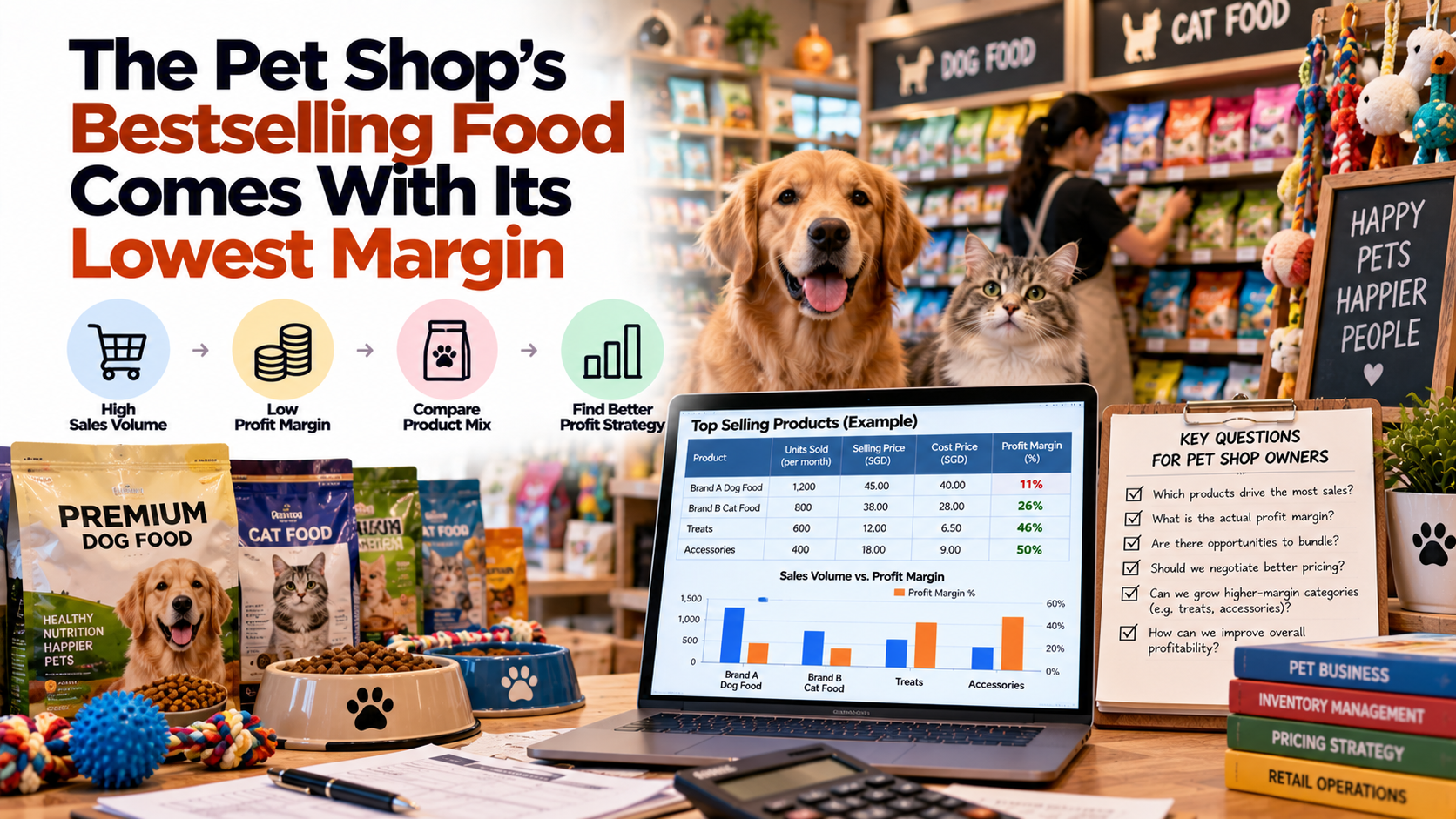
The Pet Shop’s Bestselling Food Comes With Its Lowest Margin
Every week, the same bags of pet food move from the stockroom to the shop floor and out through the checkout. Customers recognise the brand, ask for it by name and return when their supply runs low. It leads the sales report, yet the owner notices that it leaves less gross profit per dollar of sales than almost anything else in the store.
Removing the product could upset regular customers. Continuing to promote it without examining the numbers could leave the business working harder for very little return. The decision becomes more difficult when supplier discounts, loyalty rewards and free delivery all affect what the shop actually earns.
Kazuma provides accounting support that helps businesses maintain clearer financial information. For a pet retailer, that information can support a practical question: does the bestselling food contribute enough through its own sales and the customer relationships it supports to justify the cash, space and effort it requires?
Find Out What the Report Means by “Lowest Margin”
Start by checking how the margin is calculated. Gross profit is the difference between net sales and the cost of the goods sold. Gross margin expresses that profit as a percentage of net sales. A product with a low percentage can still generate substantial gross profit if it sells frequently enough.
For example, a hypothetical bag sold for S$80 with a purchase cost of S$68 produces S$12 in gross profit, or a 15% gross margin. An accessory sold for S$20 with a cost of S$10 produces a 50% gross margin, but only S$10 in gross profit per unit. Neither percentage establishes which product contributes more over a month.
Keep the comparison consistent. Use selling prices after discounts and returns, and a consistent treatment of taxes and purchase costs. A report comparing full-price food sales with discounted accessory sales, or using outdated supplier costs, can send the owner towards the wrong decision.
Follow the S$12 Beyond the Checkout
Gross profit does not show everything the retailer spends to fulfil a sale. Payment processing, marketplace charges, delivery subsidies and additional packaging can reduce what remains. These costs may differ considerably between a customer collecting one bag in-store and an online customer ordering the same bag for home delivery.
Suppose the illustrative S$80 bag generates S$12 in gross profit. A particular online order then incurs S$2 in transaction charges, S$6 in delivery expenditure absorbed by the shop and S$1 in packaging. Only S$3 remains before other operating expenses. These figures are hypothetical and are not estimates of prevailing fees.
If the shop also applies a S$4 voucher at its own expense, that order contributes negative S$1 under the same assumptions. The product has not changed, but the selling arrangement has. Where the voucher is already deducted from net sales, do not subtract it again in the contribution calculation.
This is why a product-level average needs a channel-level review. Strong in-store performance can conceal weak delivered orders, while a blended margin can make both appear acceptable.
Check Whether Related Purchases Really Support the Food
The familiar argument is that customers come for food and buy other products while they are there. That may be true, but the shop should test it using transaction records. Count how many food purchases include another item and how much contribution those additional items generate.
Separate food-only baskets from baskets containing treats, grooming products or accessories. Look at the amounts earned after discounts, rather than simply comparing total basket values. Adding another heavily discounted product may increase revenue without improving the economics very much.
Be careful about attributing every related purchase to the food. A customer might have bought the accessory anyway, or a promotion may have moved spending from one visit to another. Transaction patterns show association; they do not automatically prove that removing the food would eliminate all those sales.
The useful outcome is a measured view of the product’s role. If food-only orders dominate and require subsidised delivery, the economics deserve a different response from a product that consistently supports worthwhile mixed baskets.
Measure Repeat Business Over a Realistic Period
A recurring food purchase can create a valuable customer relationship, but repeat revenue is not the same as repeat profit. A customer who returns every month for an order that loses money does not become profitable merely through frequency.
Review identifiable customer groups over several purchase cycles using records the business appropriately maintains. Compare their spending, discounts, fulfilment costs and returns. Where customer identification is incomplete, acknowledge that limitation rather than presenting an exact lifetime value that the data cannot support.
Also distinguish new-customer incentives from ongoing benefits. A one-off introductory discount may have a different purpose from a permanent subsidy. Set a review point for the offer and examine whether later purchases generate enough contribution to support the initial cost.
This keeps customer retention grounded in evidence. The owner can recognise the value of dependable repeat visits without assuming that all future spending will compensate for today’s weak margin.
Look at Cash Tied Up in the Stockroom
A bestselling product can still absorb a significant amount of cash. Large bags require storage, supplier minimums may exceed immediate needs, and different formulas or pack sizes can sell at very different speeds. A strong brand-level sales total may conceal slow-moving variants.
Review stock by individual product code. Compare quantities on hand with recent sales, expected replenishment time and upcoming supplier payments. Separate dependable demand from a temporary promotional spike before using it to justify the next purchase.
In a hypothetical example, 100 bags costing S$68 each require S$6,800 of stock funding. If the shop buys well ahead of demand, that cash remains committed until the bags sell. Customer payments received quickly do not eliminate the funding gap created by purchasing too much too early.
The question is not simply whether the stock will eventually sell. It is whether the quantity held is necessary and whether the same cash is needed for other products, payroll or rent before those sales occur.
Treat Bulk Discounts as a Separate Decision
A supplier may offer a better unit price if the shop increases its order. That can improve margin, but the owner should compare the saving with the additional commitment. A small discount is less attractive when it creates several extra months of stock.
Check the exact conditions. The offer may require a mix of fast and slow sellers, payment before delivery or a purchase target across several periods. A rebate that depends on future volume should not be treated as a guaranteed saving in every decision scenario.
Expiry dates and return arrangements matter too. Record the remaining shelf life of incoming stock and establish whether the supplier accepts returns or exchanges under the actual agreement. Do not assume that surplus bags can be returned simply because the supplier has helped on a previous occasion.
Prepare the comparison both with and without any uncertain rebate. This makes it clear whether the purchase stands on its own or depends on an outcome the shop has not yet secured.
Give Shelf Space a Commercial Purpose
Shelf space is limited, but the highest-margin item does not automatically deserve the largest display. A fast-selling food may generate more total contribution from its space than a slow-moving accessory with a much higher percentage margin.
Compare products over a consistent period and consider how much display and storage space they require. Include the practical effect of frequent replenishment, bulky packaging and stockroom congestion. The relevant alternative is a product the shop could realistically sell in that space, not an imagined perfect performer.
There may also be room to change the display without removing the product. A smaller display supported by reliable replenishment could preserve availability while freeing space for other lines. The owner should test whether that arrangement affects sales or merely reduces excess stock on the floor.
This makes the space decision more precise. The shop may need the bestselling food in its range without needing every flavour, pack size and promotional stack in equally prominent positions.
Protect Product Suitability When Changing the Range
A financial review should not encourage staff to push unsuitable food merely because it offers a better margin. Customers may have specific requirements for their pets, and the retailer’s credibility depends on providing accurate product information and respecting those needs.
The commercial response can focus first on how the product is sold. Delivery terms, purchasing quantities, promotion rules and stock availability may offer scope for improvement without asking customers to change food. Staff should understand those options before a margin target changes their recommendations.
Where the shop considers reducing variants, communicate clearly and consider whether special ordering is practical. A predictable ordering arrangement may serve a regular customer while reducing speculative stockholding. It still needs workable supplier quantities and fulfilment costs, so it should be assessed rather than offered automatically.
Test Changes That Address the Actual Problem
Once the main source of weak contribution is understood, choose a targeted adjustment. If single-bag deliveries are expensive, review the delivery charge or collection offer. If stock levels are excessive, revise replenishment. If discounts overlap, clarify which offers can be combined.
Avoid assuming that larger baskets always solve the problem. Two heavy bags may cross a courier weight threshold, while a free gift may add another cost without changing the customer’s purchase decision. Calculate the economics of the proposed offer before launching it.
Run a limited test and record the result. Compare contribution, order volume, complaints and repeat purchases over an appropriate period. Note other changes, such as supplier price increases or seasonal promotions, that could affect the comparison.
A test should have a decision attached to it. Management needs to know what result would justify continuing, revising or stopping the offer. Otherwise, a temporary promotion can become a permanent commitment without anyone reviewing its effect.
Keep Common Overheads in Perspective
The product must contribute towards running the shop, but an allocated share of rent does not necessarily disappear if the product is removed. For a decision about keeping or changing the line, focus on the future revenue and costs that would actually change, including realistic alternative uses of scarce resources.
That does not make rent, salaries or other common expenses unimportant. Across the business, total contribution must still support those costs. The distinction helps management avoid dropping a useful product because of an arbitrary allocation while retaining an overall view of shop profitability.
Kazuma’s accounting support can provide the underlying records for this assessment. Consistent sales and cost information allows management to discuss the product’s role using a common set of figures, rather than relying on sales volume alone.
Build a Review the Owner Can Use Every Month
A manageable monthly review can show net sales, units sold, gross profit, channel-specific costs, stock on hand and ageing. Add a view of mixed baskets and repeat purchasing where the records support it. The aim is to explain what changed and identify a practical response.
Assign responsibility for keeping supplier prices and promotional terms current. A margin report loses value if it continues using last quarter’s cost after a price increase. Similarly, supplier credits and customer discounts need to be reflected consistently so that comparisons remain meaningful.
Review exceptions as well as averages. A popular line may perform well overall while a particular size, delivery channel or recurring offer consistently reduces earnings. Addressing that specific weakness can be more effective than making a broad decision about the entire brand.
Keep the Bestseller for a Reason the Numbers Support
The bestselling food may deserve its place because it produces steady contribution, supports valuable customer relationships or fills a genuine need in the shop’s range. Its low margin percentage alone is not a reason to remove it. Equally, popularity does not justify unlimited discounts, excessive stock or loss-making fulfilment.
Bring the product’s sales, related purchases, stock commitment and selling costs into one review. Identify which benefits are demonstrated and which remain assumptions. Then adjust the purchasing or selling arrangement that is causing the problem.
Speak with Kazuma about its accounting support if the business needs clearer financial records behind these decisions. A dependable bestseller becomes more valuable when the owner can explain how it supports the shop, how much cash it requires and what remains after each sale.