
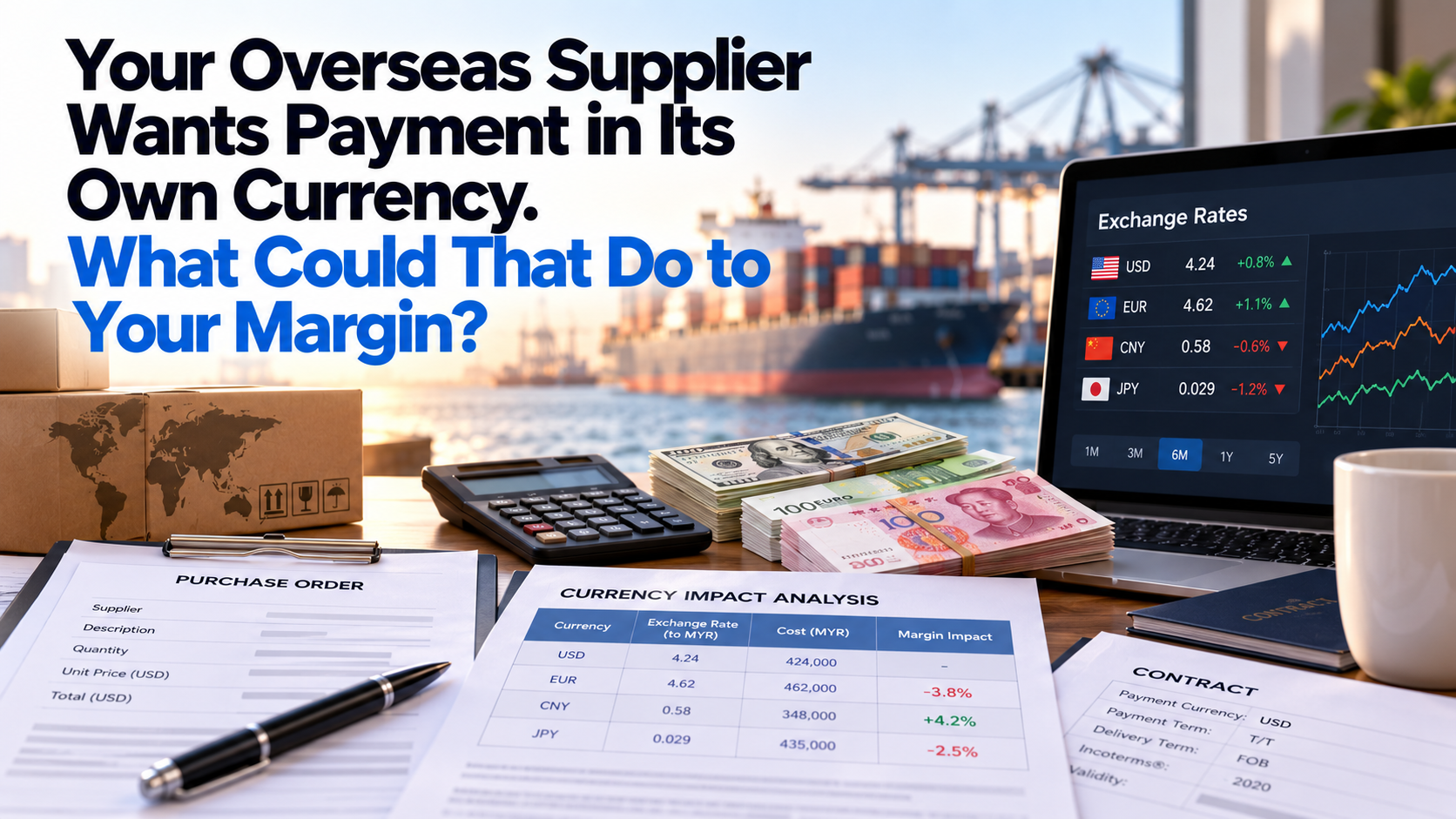
Your overseas supplier offers a competitive price, but there is one condition: payment must be made in the supplier’s currency. Your customers pay you in Singapore dollars, so finance converts the quotation, checks the expected margin, and approves the purchase.
Several weeks later, the payment falls due. The supplier has not changed its price, yet the Singapore-dollar amount needed to settle the invoice has increased. The order still generates revenue, but less money remains than management expected.
For importers and trading companies, this is a practical pricing and cash-planning issue. Before accepting a foreign-currency quotation, understand when the exchange rate can affect the transaction, how much movement your margin can absorb, and who is responsible for monitoring the exposure.
Identify What Has Changed in the Commercial Arrangement
If the supplier previously invoiced in Singapore dollars, ask what the new currency arrangement changes. The supplier may be offering a lower price, seeking more certainty over its own receipts, or changing its standard billing terms.
Compare the complete proposals. Consider the quoted amount, payment schedule, conversion costs, and any other differences in the purchase terms. A foreign-currency quotation that looks cheaper at today’s rate may produce a different result when payment is eventually made.
Request a clear written quotation stating the currency, amount, validity period, and payment dates. Avoid relying on a converted figure in an email if the binding obligation is expressed in another currency. Everyone approving the purchase should understand which amount is fixed and which remains exposed to movement.
Follow the Transaction From Quotation to Collection
There can be several important dates between agreeing on a purchase and receiving payment from your customer. Your team may quote the customer first, place the supplier order later, pay a deposit, receive the goods, settle the balance, and collect the sales invoice weeks afterwards.
Map those events before assessing the risk. Once you commit to a fixed customer selling price, your ability to recover a higher purchasing cost may be limited. The supplier payment can remain exposed even though the sales team considers the margin agreed.
For example, a quotation valid for thirty days may allow a customer to accept near the end of that period. If your supplier price remains payable in foreign currency, the exchange rate used when preparing the quotation may already be outdated when the order is confirmed.
See How a Currency Movement Changes the Amount Remaining
Consider a simplified hypothetical purchase of US$50,000. Assume the business expects to sell the goods for S$85,000 and incur another S$7,500 of relevant costs. Ignore GST, financing costs, conversion fees, and accounting timing differences for this illustration.
At an assumed rate of S$1.30 for US$1, the supplier payment would cost S$65,000. After deducting that payment and the other S$7,500, the transaction would leave S$12,500 before remaining business costs.
If the rate instead becomes S$1.38 for US$1 when payment is made, the supplier payment would cost S$69,000. The amount remaining would fall to S$8,500, a reduction of S$4,000, or 32%.
These are illustrative rates, not current market quotations or forecasts. The example shows how a relatively modest increase in purchasing cost can consume a much larger proportion of the amount you expected to earn.
Check the Direction and Basis of the Rate
Exchange-rate quotations can be presented in different ways. A rate expressed as Singapore dollars per US dollar is different from one expressed as US dollars per Singapore dollar. Confusing the two can lead to an incorrect calculation.
Label the rate clearly in quotations, forecasts, and payment schedules. Record which currency is being bought, which currency is being sold, and whether the calculation requires multiplication or division.
Also distinguish a reference rate from the rate your business can actually obtain. An online rate may be useful for an initial estimate but may not include the conversion spread or charges applying to your transaction. Obtain comparable quotes before assessing the final cost.
Include Conversion and Payment Charges
The exchange rate is only one part of the cost of paying an overseas supplier. Depending on the arrangement, conversion spreads, transfer charges, and intermediary-bank deductions may affect the amount paid or received.
Clarify whether the supplier requires the full invoiced amount to arrive in its account and who bears the relevant charges. A transfer that leaves the supplier short may require another payment and additional administration.
When comparing payment options, compare the total Singapore-dollar outflow needed to satisfy the same obligation. A low advertised transfer fee does not automatically mean a lower overall cost if the conversion rate is less favourable. Keep the assumptions consistent so that the comparison is meaningful.
Work Out How Much Movement the Order Can Absorb
A useful pricing review tests several exchange-rate scenarios rather than relying on one figure. Estimate the outcome at the planning rate and under plausible adverse movements, then consider whether the remaining return is acceptable.
Using the earlier example, suppose management wants at least S$10,000 left after the specified costs. With sales of S$85,000 and other costs of S$7,500, the maximum supplier payment consistent with that objective would be S$67,500.
For a US$50,000 payment, that corresponds to S$1.35 per US$1 before any excluded charges. This is an internal review point based on the stated assumptions, not a market prediction or a complete break-even rate for the business.
Establish what happens if the forecast approaches that point. The response might involve reviewing the selling price, discussing supplier terms, or reconsidering whether the order meets the company’s requirements.
Keep Customer Pricing and Supplier Currency Decisions Connected
Sales and purchasing can each make reasonable decisions that create a poor combined result. Sales may promise a fixed Singapore-dollar price while purchasing accepts a foreign-currency obligation without knowing how little pricing flexibility remains.
Give both teams a common costing approach. Identify which exchange-rate assumption should be used, how long a quotation remains valid, and when finance should review the margin before a commitment is made.
Where commercially appropriate, discuss shorter quotation validity, periodic price reviews, or an agreed currency adjustment mechanism with customers. Any such arrangement needs clear terms and customer acceptance. Do not assume you can increase an agreed price later simply because your purchasing cost has risen.
Consider Payment Timing Without Ignoring Other Risks
Paying earlier may fix the conversion cost sooner, but it also uses cash earlier and can increase exposure to supplier non-performance. Delaying conversion preserves cash for longer while leaving the currency cost uncertain.
Assess these trade-offs together. An early-payment discount should be compared with the funding requirement, conversion cost, and commercial protection available if the supplier fails to deliver.
For example, paying the entire amount before production may reduce one uncertainty while creating another. Management should understand the supplier relationship, contractual safeguards, and effect on available cash before treating early payment as the preferred response to currency risk.
Look for Receipts and Payments in the Same Currency
If the business also receives money in the supplier’s currency, those receipts may help fund the payment without converting the full amount from Singapore dollars. This is sometimes described as a natural offset.
Check the amounts and dates carefully. A receipt expected next quarter does not fund a supplier payment due next week. Nor should an uncertain customer collection be treated as equivalent to cash already available.
Review other uses for the foreign-currency balance as well. The same money cannot cover several obligations at once. A simple schedule of expected receipts, payments, and existing balances can help management identify the genuine net amount requiring attention.
Understand What a Forward Contract Commits You To
A foreign-exchange forward contract can fix an exchange rate for an agreed amount and future date. This can provide greater certainty over a planned payment, but it creates a commitment rather than merely reserving an attractive rate.
Before entering one, discuss the amount, maturity, credit requirements, and consequences of a delay, cancellation, or change in the supplier payment with the provider. Understand potential costs of changing or closing the arrangement and the effect if market rates later move favourably.
The objective should be managing an identified business exposure. Avoid committing to an amount based only on optimistic purchasing forecasts. Accounting for the instrument also requires attention, and qualifying for hedge accounting is a separate assessment rather than an automatic consequence of calling the contract a hedge.
Distinguish Commercial Cost From Accounting Presentation
The actual Singapore-dollar cash paid matters commercially, but it may not appear entirely within the inventory purchase cost or gross margin in the financial statements.
Under the usual IAS 21 principles and corresponding Singapore requirements, initial recognition uses the transaction-date exchange rate. An unpaid foreign-currency monetary liability is retranslated at the reporting-date closing rate, with exchange differences generally recognised in profit or loss. Historical-cost inventory is not simply retranslated each time the payable changes.
Consequently, a currency movement may appear separately from the original inventory cost. Advance payments, hedging arrangements, and other circumstances can affect the analysis. Confirm the treatment under the company’s applicable framework and keep management’s order analysis reconcilable to the accounts.
This distinction helps explain why a report can show a stable product gross margin while foreign-exchange losses reduce the overall result. Management needs visibility of both measures without counting the same movement twice.
Monitor Outstanding Commitments Before the Invoice Arrives
Currency exposure can arise commercially before a supplier invoice is entered into accounts payable. A confirmed purchase order or fixed customer quotation may already leave the company vulnerable to a change in exchange rates.
Maintain a schedule that distinguishes proposed purchases, committed orders, recognised payables, and settled transactions. Include the currency, amount, expected payment date, and any action already taken to manage the exposure.
For example, a monthly accounts payable report may show only a small foreign-currency balance while purchasing has placed several large orders awaiting delivery. Reviewing the ledger alone would provide an incomplete picture of upcoming funding needs.
Assign Responsibility for Decisions and Review
Decide who monitors exposure, who approves conversions or other arrangements, and when an issue must be escalated. These responsibilities should match the size and complexity of the business.
A small trading company may need a straightforward review of major payments and pricing assumptions. A business with frequent transactions across several currencies may need more regular reporting and clearer approval limits.
Keep a record of the reasoning behind significant decisions. This allows management to assess whether the process was followed and whether assumptions need improvement. Judge decisions against the information and policy available at the time, rather than only whether the exchange rate later moved in the company’s favour.
Review the Actual Result After Settlement
When the order is complete, compare the original costing with the actual outcome. Separate changes caused by exchange rates from supplier price changes, freight costs, customer discounts, and operational issues.
Use that review to improve future quotations and budgets. If the same variance appears repeatedly, the planning rate, quotation period, or purchasing process may need revision.
Avoid treating favourable currency movements as proof that the underlying margin is strong. A profitable outcome supported by an exchange gain may not repeat. Understanding the source of the result helps management make a more realistic decision about the next order.
Build the Decision on Clear Financial Information
Kazuma Public Accounting Corporation provides accounting and periodic financial reporting services, together with accounting standards advisory. For companies with budgeting systems, its reporting support can also include budget-to-actual analysis as needed.
These services can help management understand how purchasing commitments, outstanding balances, and currency movements appear in the company’s financial information. Specific treasury products and contractual arrangements should be discussed with the relevant banking or specialist advisers.
Before accepting payment terms in an overseas supplier’s currency, connect the purchasing decision with customer pricing, payment dates, and cash availability. Know the assumptions behind your expected margin and establish when they need review. That gives the business a clearer basis for deciding whether the supplier’s offer remains attractive after currency exposure is taken into account.