
The Deadline Is Monday, but the Numbers Need Until Friday
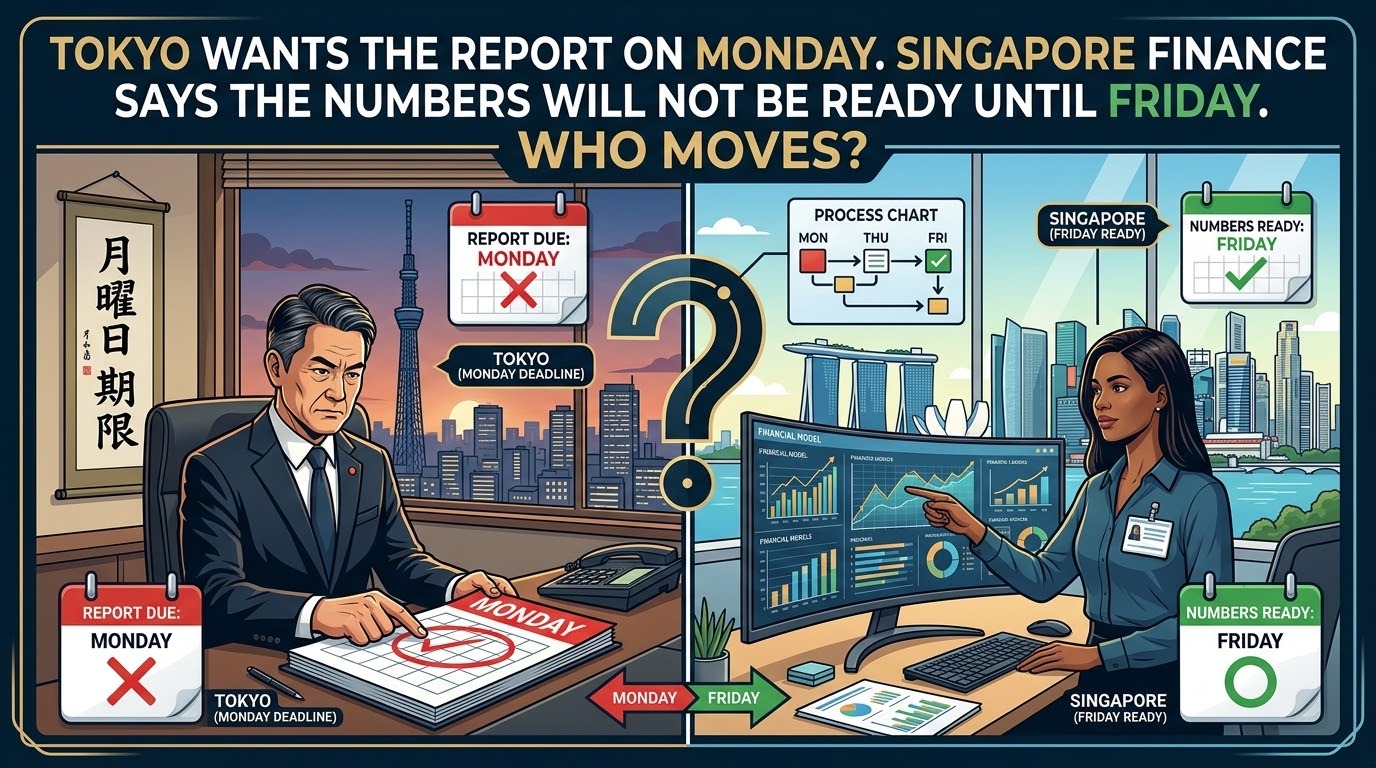
It is Thursday afternoon in Singapore when an email arrives from Tokyo head office. The message is short and clear: the monthly reporting package must be submitted by Monday morning so that group finance can begin consolidation. Singapore finance looks at the request and immediately sees a problem. Several supplier invoices have not arrived, the payroll reconciliation is still being reviewed, intercompany balances have not been confirmed, and one large customer transaction needs clarification before revenue can be finalised. The finance manager believes Friday is the earliest date the team can produce numbers it is comfortable standing behind. Tokyo says Monday. Singapore says Friday. At first glance, someone simply has to compromise. Yet the real problem is usually more complicated than choosing between two dates. It is about how multinational companies balance reporting speed with financial reliability, and whether the reporting process has been designed to satisfy both local operations and head office expectations.
Tokyo Is Not Asking for Monday Just to Make Singapore’s Life Difficult
From Singapore’s perspective, the Monday deadline can appear unnecessarily aggressive. Head office may seem disconnected from the amount of work required to close the books locally. However, Tokyo is rarely waiting for only one subsidiary. A parent company may be collecting financial information from subsidiaries across Singapore, Malaysia, Thailand, Indonesia, China, Australia and other markets. Those numbers must then be reviewed, reconciled, adjusted and consolidated before group management can analyse the overall result. If Singapore submits four days late, the impact may extend beyond Singapore because another team is waiting for its information. Kazuma Public Accounting Corporation’s services reflect this reality by supporting monthly, quarterly and other periodic parent-company reporting, consolidation packages and reporting to overseas head offices. A deadline that feels arbitrary to one subsidiary may therefore be an essential part of a much larger group reporting calendar.
Singapore Finance Is Not Necessarily Making Excuses Either
The local finance team’s concern can be equally legitimate. Closing accounts is not simply a matter of pressing a button and exporting a report. Bank balances need to be reconciled, transactions need to be recorded in the appropriate period, accruals may need to be estimated, intercompany balances must be checked, foreign currency transactions may require review, and unusual items may need explanations from departments outside finance. If the Singapore team submits information before completing important procedures, head office may receive numbers that change significantly several days later. A fast report that needs repeated corrections can create more work than a slightly later report that is reliable. The challenge is therefore not deciding whether Tokyo or Singapore is being unreasonable. It is determining what information must genuinely be complete before Monday and what can reasonably be finalised afterwards.
Fast Reporting and Accurate Reporting Should Not Be Opposing Goals
Companies sometimes frame the problem as a simple choice between speed and accuracy. Head office wants speed while local finance wants accuracy. A well-designed reporting process should aim for both. The objective is not to force finance employees to work faster indefinitely, nor is it acceptable for a subsidiary to require several weeks to understand its own monthly financial position. The better question is what prevents reliable information from being available sooner. Perhaps invoices arrive too late. Maybe operational departments submit information only after finance chases them. Intercompany confirmations could be performed only at month-end instead of throughout the month. The company may rely on manual spreadsheets that take days to update. When the same deadline conflict happens every month, it stops being a scheduling problem and becomes a process problem.
Start by Asking Why Friday Is Necessary
If Singapore says the report cannot be ready until Friday, management should understand what specifically requires the additional four days. “Finance needs more time” is not sufficiently precise. Does the team spend two days waiting for sales information? Are supplier invoices arriving late? Is someone manually reconciling hundreds of transactions? Does one manager need to approve every adjustment? Is the team waiting for another subsidiary to confirm an intercompany balance? Perhaps the accounting system cannot produce the information in the format requested by head office. Breaking the closing process into individual tasks allows management to see where time is actually being consumed. Without that analysis, the company may spend years arguing about deadlines without addressing the reason those deadlines are difficult to meet.
The Monthly Close Should Not Begin on the Last Day of the Month
One common misconception is that month-end closing starts when the month ends. In reality, much of the preparation can happen earlier. Finance can maintain reconciliations throughout the month, review unusual transactions before the final day, keep fixed asset records current and follow up on unresolved intercompany differences before reporting week begins. Departments can also be reminded of cut-off dates in advance instead of receiving urgent requests after month-end. The more work that accumulates until the first working day of the new month, the more difficult an early reporting deadline becomes. A faster close often begins with better financial discipline during the month rather than asking accountants to work longer hours after it ends.
Waiting for Every Invoice Can Make the Close Unnecessarily Slow
Supplier invoices are a common reason finance teams say accounts are not ready. However, financial reporting does not necessarily require every physical or electronic invoice to have arrived before management can estimate obligations appropriately. If services have already been received or costs have been incurred, finance may need a reliable process for identifying and recording accruals based on available information. The important issue is whether the company’s estimation process is sufficiently disciplined and whether significant amounts are subsequently reviewed. If Singapore routinely waits several additional days because operational departments submit invoices late, the underlying issue may not be the reporting deadline at all. It may be the company’s purchasing and information flow.
Intercompany Reconciliation Should Not Become a Monthly Emergency
Multinational groups frequently lose valuable closing time resolving intercompany differences. Singapore records S$500,000 payable to another group company while that company reports only S$470,000 receivable from Singapore. Finance then spends several days exchanging spreadsheets, searching for invoices and investigating timing differences. The problem becomes more difficult when similar discrepancies exist across numerous entities. A better process is to reconcile significant intercompany transactions regularly and establish clear cut-off procedures before month-end. Kazuma’s parent-company reporting and consolidation support includes helping Singapore subsidiaries prepare information required for group consolidation, while its audit services include group audit and consolidation support. These services reflect how important consistent information becomes once a business operates as part of a larger group.
Head Office Should Decide What “Monday” Actually Means
Another useful question is what Tokyo truly needs on Monday. Does it require completely finalised statutory-quality accounts, or does it need a sufficiently reliable management reporting package to begin consolidation? Those are not necessarily the same thing. Some groups operate a preliminary close followed by a final close, allowing management to receive early information while selected adjustments continue to be reviewed. Others establish thresholds for late adjustments so that insignificant items do not repeatedly reopen the reporting package. The appropriate approach depends on the organisation and its reporting requirements, but the deadline becomes easier to manage when everyone understands what level of finality is expected. Simply writing “final numbers due Monday” can create unnecessary conflict if Singapore and Tokyo interpret “final” differently.
Materiality Can Prevent Small Items From Holding Up Large Reports
Imagine Singapore has completed a reporting package containing millions of dollars of transactions but is waiting for a S$700 invoice before submitting it. Unless the item has some unusual significance, management should question whether waiting for it improves the usefulness of the report. Financial reporting involves judgement, and companies need clear policies for handling minor late information. This does not mean small transactions can simply be ignored. It means the closing process should distinguish between information capable of materially changing the financial picture and information that can be handled through established accrual or subsequent adjustment procedures. Without this discipline, a finance team can spend disproportionate time pursuing tiny differences while important analytical work remains unfinished.
A Faster Close Requires Earlier Decisions About Estimates
Some financial statement amounts cannot be known with absolute certainty at the reporting date. Accrued expenses, provisions and other estimates may require judgement based on the information available. If management refuses to accept any estimate until every supporting document is available, the reporting process can become unnecessarily slow. Conversely, aggressive estimation simply to meet a deadline can reduce reliability. The organisation needs consistent methodologies, appropriate review and clear thresholds so that estimates can be prepared efficiently without becoming arbitrary. Over time, finance can compare estimates with actual outcomes and improve the process. The goal is not to guess faster. It is to build a reliable system for making reasonable estimates when exact information is not yet available.
Repeated Adjustments Can Destroy Head Office’s Confidence
Suppose Singapore agrees to Monday and sends its numbers on time. On Tuesday it changes profit by S$100,000. Wednesday brings another S$50,000 adjustment. Thursday brings an intercompany correction, followed by a tax adjustment on Friday. Technically, Singapore met the deadline, but head office may have had to reopen consolidation repeatedly. Eventually, Tokyo may stop trusting the first version of Singapore’s numbers. Speed without stability can therefore be misleading. A good reporting process should measure not only whether the package was submitted on time but also how many significant post-submission adjustments were required. If on-time reporting is improving while adjustment frequency is rising, the organisation may simply be moving errors earlier rather than improving the close.
Being Consistently Late Is Not Evidence of Quality
The opposite problem also occurs. Finance teams sometimes defend slow reporting by saying they refuse to compromise accuracy. Accuracy is essential, but a company should still ask why accurate information takes so long to produce. A business that needs several weeks every month to determine its financial position may have weaknesses in processes, systems, responsibilities or data quality. Management needs timely information to make decisions. A beautifully accurate report delivered after the information has lost much of its usefulness is not automatically a successful reporting process. Quality financial management involves producing information that is both dependable and timely enough to influence decisions.
Too Many Spreadsheets Can Add Days to the Close
A multinational subsidiary can have a modern accounting system and still perform much of its reporting through spreadsheets. The accounting software produces one trial balance, which is exported into another file, mapped into a parent-company template, adjusted through several worksheets and then copied into a consolidation package. Another employee maintains a separate intercompany file, while tax information sits in another workbook. Each manual transfer introduces time and the possibility of error. Spreadsheets remain useful, but management should identify recurring manual work that could be standardised or automated. If employees spend several days every month copying the same information between the same files, the process deserves attention.
Changing Software Will Not Automatically Fix a Bad Closing Process
When reporting takes too long, management may immediately conclude that the company needs a better accounting system. Technology can certainly help, but software cannot compensate for unclear responsibilities or poor discipline. If departments submit information late, a new system may simply receive late information more efficiently. If nobody owns the intercompany reconciliation, automation does not resolve the accountability problem. If head office changes its reporting template every few months without proper communication, Singapore will still struggle. Technology works best when the underlying process has already been understood and unnecessary steps have been removed. Otherwise, companies risk digitising an inefficient workflow instead of improving it.
One Employee Should Not Be the Only Person Who Knows How the Package Works
Group reporting can become highly dependent on individual knowledge. Perhaps one senior accountant knows exactly how Singapore’s chart of accounts maps into Tokyo’s consolidation template. That person understands which adjustments recur every month, which intercompany differences are normal and what explanations head office expects. Everything works until the employee takes leave during reporting week or resigns. Suddenly, Monday becomes impossible. Multinational subsidiaries should document important reporting procedures sufficiently so that knowledge belongs to the organisation rather than one employee. Cross-training and review also help identify processes that have become unnecessarily complicated because everyone simply follows the method created years earlier.
Head Office Can Create Inefficiency Too
The responsibility for improving reporting does not sit entirely with Singapore. Parent companies can create substantial work through inconsistent instructions, frequent template changes and requests for information that nobody ultimately uses. If Tokyo asks every subsidiary to complete 100 reporting fields but group management actively analyses only 30, the remaining 70 deserve review. Standardisation is valuable, but standardisation should not become bureaucracy for its own sake. Head office should periodically ask whether each report, schedule and deadline still serves a meaningful purpose. Removing unnecessary reporting requirements can improve both speed and quality because local finance teams have more time to focus on information that actually matters.
A Deadline Should Reflect the Entire Reporting Chain
The best reporting calendar is designed backwards from the final group requirement. If the board needs consolidated results on a particular date, group finance needs sufficient time before that to review and consolidate subsidiary information. Subsidiaries then need appropriate deadlines for their reporting packages, while local departments require earlier internal cut-offs to provide information to finance. When every deadline is connected, employees understand why Monday matters. Problems arise when deadlines are imposed without considering the work required at each stage. A realistic calendar does not mean giving everyone as much time as they want. It means allocating time according to the actual sequence of work.
Measure the Close Instead of Arguing About It
Rather than debating whether five days or nine days is reasonable, companies can measure what happens during the close. Which tasks take longest? Which information arrives late most often? How many manual adjustments are made? How many significant changes occur after submission? How many hours does finance spend preparing the package? Which head-office questions recur every month? Data can turn an emotional discussion into a process-improvement exercise. If 40% of closing time is spent waiting for two departments, management knows where to focus. If the reporting package is ready early but sits for two days awaiting one approval, the bottleneck becomes obvious.
The Best Closing Process Gets Faster Without Becoming More Fragile
A company can sometimes shorten its reporting timetable simply by asking employees to work late for several nights. That may succeed temporarily, but it is not genuine process improvement. A sustainable faster close comes from reducing unnecessary work, improving data quality, moving activities earlier, automating repetitive steps and clarifying responsibilities. The process should become more reliable as it becomes faster, not increasingly dependent on heroic effort from finance employees. If every month-end requires midnight work just to satisfy head office, management should examine the system rather than praising the team for repeatedly rescuing it.
Singapore Management Also Needs the Numbers Quickly
It is easy to frame the deadline as Tokyo’s requirement, but Singapore management should also want timely financial information. A subsidiary cannot manage effectively if it learns several weeks later that margins deteriorated, expenses exceeded budget or receivables increased sharply. Faster financial reporting benefits local decision-making as much as group consolidation. The question therefore should not be, “How quickly can we send Tokyo something?” It should be, “How quickly can we understand our own business with sufficient confidence?” When those objectives align, head-office reporting becomes less of an external burden and more of an extension of good local financial management.
Parent Company Reporting Requires More Than Sending a Trial Balance
For multinational corporations, the report requested by Tokyo may contain far more than the Singapore trial balance. Parent companies may require consolidation packages, explanations of significant movements, tax-effect accounting, budget comparisons, intercompany information and reports prepared according to group accounting policies. Kazuma Public Accounting Corporation specifically supports monthly, quarterly, semi-annual and annual financial reporting from Singapore subsidiaries to parent companies, including reporting aligned with parent-company accounting standards and explanations provided to head office. This is important because the reporting deadline cannot be evaluated purely by asking how quickly accounting software can generate a profit and loss statement. The real workload depends on what the group needs to do with the information.
The Audit Calendar Should Be Considered at the Same Time
Year-end reporting adds another layer because local statutory requirements, parent-company reporting and audit procedures may operate simultaneously. The Singapore team may be preparing financial statements while responding to a local auditor and completing a consolidation package for the parent company’s group auditor. Poor coordination can result in the same information being prepared several times in different formats. Kazuma’s audit practice includes statutory audits, parent-company consolidation package audits, group audit support, head-office reporting and assistance where a parent-company-appointed external auditor conducts the engagement. Coordinating these requirements early can reduce duplication and prevent year-end from becoming a series of competing emergencies.
Kazuma Public Accounting Corporation Understands Both Singapore and Head Office Requirements
This is where Kazuma Public Accounting Corporation has a particularly relevant position. Kazuma works with SMEs and multinational corporations in Singapore and provides accounting, audit, tax, corporate compliance and transaction-related services. Its accounting support includes monthly and quarterly reporting, parent-company financial reporting and consolidation package preparation, while its audit services include head-office reporting, consolidation package audits and group audit support. For Singapore subsidiaries, this means the reporting conversation does not need to stop at local bookkeeping. The objective is to maintain accurate Singapore records while ensuring the information can be delivered in a form and timetable that management, parent companies and auditors can actually use.
Good Communication Can Prevent Monday Versus Friday From Becoming a Crisis
Some deadline conflicts can be solved simply by communicating earlier. If Singapore knows two weeks in advance that a significant transaction will delay closing, head office can decide whether an estimate is acceptable, whether another schedule can be submitted first or whether the reporting calendar needs adjustment. The worst outcome is for Tokyo to discover on Monday morning that the package will arrive Friday. Likewise, head office should communicate changes to templates, accounting policies and deadlines sufficiently early for subsidiaries to prepare. Reporting works best when local finance and group finance operate as parts of the same process rather than as opposing teams negotiating every month.
Both Sides Should Agree on What Cannot Move
Not every element of the reporting process should be flexible. Regulatory requirements, group reporting commitments and significant accounting procedures may impose genuine constraints. The solution is to identify those constraints clearly. Perhaps the Monday consolidation deadline cannot move, but one supplementary schedule can be submitted Wednesday. Perhaps Singapore can provide preliminary numbers Monday with a defined threshold for subsequent adjustments. Perhaps a recurring Friday bottleneck can be eliminated by moving an internal cut-off two days earlier. When the organisation distinguishes fixed requirements from historical habits, it often discovers more flexibility than either side expected.
So Who Actually Moves?
If Tokyo wants Monday and Singapore says Friday, the answer should not automatically be Tokyo or Singapore. The process should move first. Management should examine why the information cannot be ready Monday, what head office genuinely needs at that point, which closing activities can happen earlier, which estimates can be standardised, which reports can be simplified and which recurring delays can be eliminated. If Monday is genuinely unrealistic after that review, head office should reconsider the timetable. If Friday exists only because the company has always closed that way, Singapore should improve the process. A good deadline is neither the earliest date head office can demand nor the latest date local finance prefers. It is the earliest date at which sufficiently reliable information can be produced through a sustainable process.
Conclusion: The Best Reporting Deadline Is the One the Process Can Reliably Meet
A multinational reporting calendar should not require Tokyo and Singapore to fight the same battle every month. Head office needs timely information because it has its own consolidation, management and audit responsibilities. Singapore finance needs enough time to produce information that is accurate, explainable and stable. Both concerns are legitimate. The long-term solution is therefore not repeatedly negotiating an extra day or asking finance employees to work later. It is designing a closing process that moves information earlier, reduces manual work, resolves recurring differences before month-end and clearly defines what is expected at each reporting stage. When that happens, Monday stops feeling like an unreasonable demand and Friday stops feeling like the only safe option.
Kazuma Helps Connect Local Finance With Parent Company Reporting
For Singapore subsidiaries of multinational and Japanese companies, reliable financial reporting needs to work in two directions. Local management needs accurate information to operate the Singapore business, while head office needs timely and consistent information for group reporting and consolidation. Kazuma Public Accounting Corporation supports that connection through accounting and bookkeeping, periodic financial reporting, parent-company reporting support, consolidation package preparation, statutory audits, consolidation package audits and group audit assistance. The objective should not be to make Singapore work according to Tokyo’s timetable at any cost, or to make Tokyo wait whenever Singapore finds a deadline difficult. It should be to build a reporting process in which both sides receive reliable information when they need it, with fewer surprises, fewer corrections and far less month-end frustration.